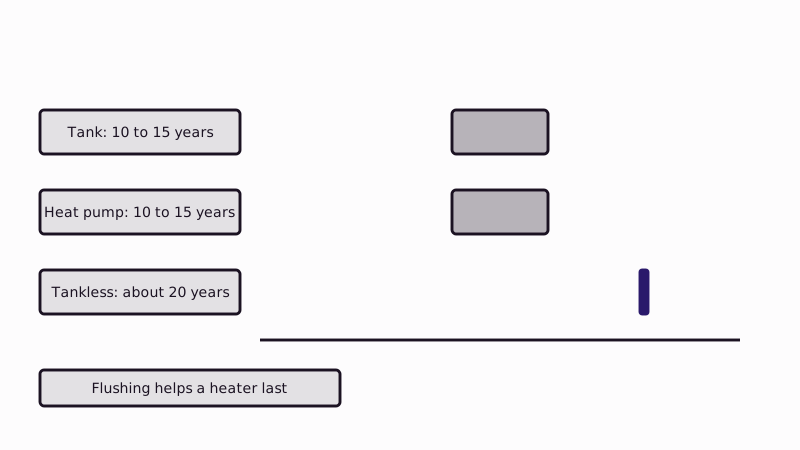
Rheem says traditional tank heaters typically last 8 to 12 years and tankless models 15 to 20 or more with proper care. By that yardstick a tank beyond ten years old is living on borrowed time, and Rheem notes that units over ten are more likely to fail again soon after a repair. Already dripping or cold? Begin at water heater repair. Still working? Read on and decide whether to wait.
What lifespan should you expect from each type of water heater?
The numbers Rheem gives: 8 to 12 years for tanks and 15 to 20 or more for tankless. They assume good conditions. A heater that gets flushed, keeps a working anode rod and sits somewhere dry and ventilated has the best shot at the high end.
Warranty length is a hint, not a promise: a six-year tank warranty often means the maker expects a decade or so of service. Tankless units last longer largely because they hold no standing water, and their parts, such as the heat exchanger and flow sensor, can be replaced individually. That makes a 15-year-old tankless worth repairing in a way a 15-year-old tank is not. Choosing between the two for a swap? Tank versus tankless lays out the tradeoffs.
How do you find out how old your heater is?
Locate the rating plate on the tank's side. Its serial number hides the manufacture date. Many brands start with a month letter and two year digits, but every maker has its own scheme, so look up the brand's format or attach a photo of the label to your request.
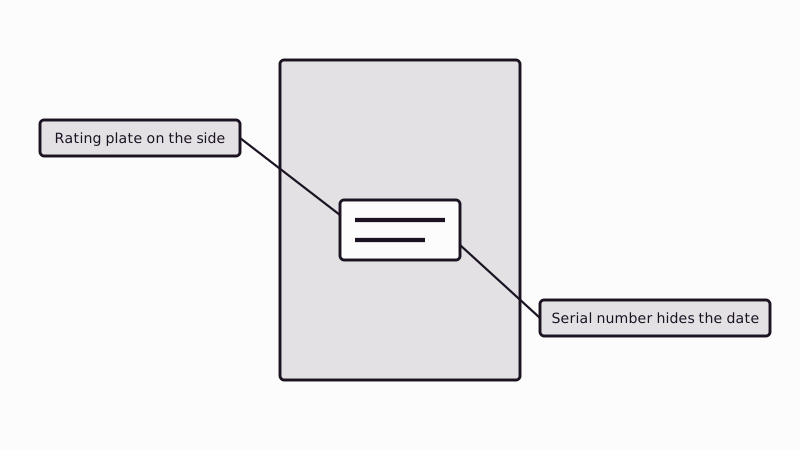
If the label has worn away, look for other evidence: a heater from the 1990s will have a different control panel and flue style than one from the last decade. Look for the permit sticker or paperwork in the home's records too. If the house was bought recently, the seller's disclosure may list the install year. Photograph the plate and the T&P relief valve and discharge pipe while you are there, since an installer will want them.
What signs say it is time to replace instead of repair?
Replace when the tank itself leaks, when it is older than about 12 and needs a big part, or when brown, rusty water flows from hot taps only. Rumbling and popping, a quote for repair that nears half of a new unit's price, and showers that run cold fast all point the same way.
A small drip from the T&P valve or a loose fitting is repairable; a puddle spreading under the tank is not, since a hole in the steel liner can't be patched. Sediment layers cause the rumble, and a tank full of scale heats slower and wastes gas or electricity. Elements, thermostats, igniters and thermocouples are cheap fixes on a sound tank. On a rusted one, they are throwing money at a heater that is already done. The deciding questions are laid out in replacing a hot water heater, and urgent cases in same-day water heater trouble.
What shortens a water heater's life around Santa Monica?
Mineral scale, a worn anode rod and salt air do most of the damage. Santa Monica's municipal water averaged 161 parts per million of hardness in its 2022 report, about 9.42 grains per gallon, which is enough to lay scale on a tank bottom or element over time.
Tanks that sit in a garage or outdoor closet near the beach can also corrode from the outside, since salt-laden air attacks the jacket and the flue. Homes served by other utilities across the Westside have a different hardness, so check your own supplier's report. Each year, draining a few gallons clears sediment; peeking at the anode rod now and then, as many makers advise, can stretch the heater's life. Read replacing the anode rod and preventing scale from hard water.
What does a replacement require in California?
Two things come with the job: a permit and an inspection. Santa Monica's homeowner guide puts hot water heater change-outs in the single-trade permit category. California also requires earthquake bracing for the new heater, a correctly piped T&P valve discharge and, on a closed system, often an expansion tank.
The tank matters when a regulator or backflow device sits on the main, because heated water then has nowhere to expand. See expansion tank replacement and the permit overview for water heaters. Applying for that permit falls to the plumber. As for air rules, regulators in the South Coast district voted in June 2025 against amending their water heater standards, which means nothing forces a swap by a date. A water heater job nearly always clears $1,000, California's contractor license threshold, and any deposit is limited to ten percent of the job or $1,000, whichever is lower.
Does a gas or electric heater change the timeline?
Not much on age, but a lot on safety. Gas heaters add combustion and venting, so a rusted flue, black soot or a pilot that won't stay lit is reason to move sooner. Electric heaters fail more quietly: a bad element or a stuck thermostat, then eventually a leaking tank.
A gas heater should never have its venting or gas connection altered by a homeowner. A gas odor means outside first, then a phone call from a safe distance to SoCalGas, 1-800-427-2200. Closets that vent a gas heater have to keep the air supply clear, so storage stacked around the unit is a hazard. Heat pump models run on electricity and sit in a space with enough air volume, which suits some garages and not a closet. Cost comparisons are in water heater replacement cost.
Common questions
Is 20 years out of reach for a tank?
Occasionally. A tank with a well-maintained anode rod, softened or moderate water and a dry setting can outlast the usual range, and Rheem says tankless units can reach 15 to 20 or more with care. But the odds tilt against it, and an old tank can fail without warning. Plan the budget before the leak arrives.
Why not just wait until it breaks?
Past ten years, or once rust or a seep appears, waiting costs more: planned work beats an emergency visit plus flood cleanup. You pick the model, the timing and the quote. A heater under ten that is working normally usually just needs a yearly flush and a check of the valves.
What does skipping the yearly flush do?
Sediment builds along the bottom, the burner or element labors, the tank rumbles and the steel under the layer corrodes faster. Hard water speeds this up. A yearly flush is a cheap habit. A drain valve seized by years of crust is a plumber's job, not something to force.
Does the warranty tell me how long it will last?
Only loosely. Warranties of six to twelve years suggest the maker expects the tank to reach the early part of the lifespan range, and they usually cover the tank, not labor or damage from a leak. Read what is covered before counting on it.
Is HVAC or heating and air work the same trade as water heaters?
Not exactly. Many shops cover both, and heat pump water heater touches both fields, but the plumbing, gas and permit side of a water heater swap goes to a plumber. Ask whether the person quoting handles the gas line, venting, expansion tank and permit.
Sunset Coast Plumbing arranges water heater work for Santa Monica and the Westside.
Sources used
Page updated