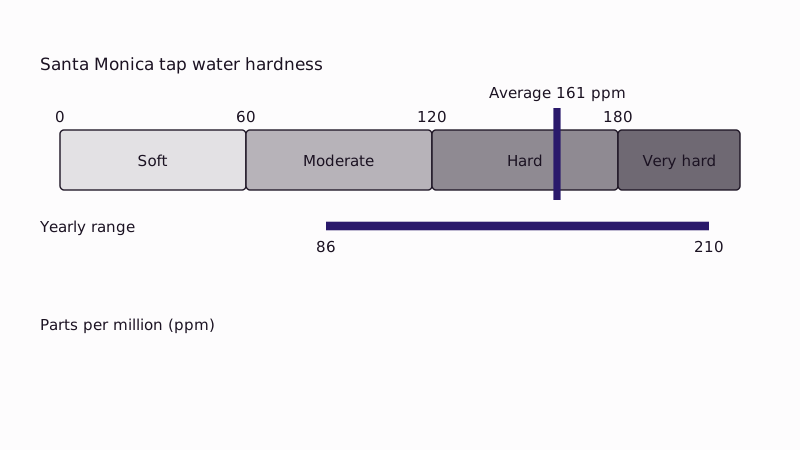
Santa Monica's own 2022 water quality report, published by the city's Water Resources Division, gives the delivered water an average hardness of 161 ppm, which the report converts to 9.42 grains per gallon, with readings between 86 and 210 across the year. On the USGS scale that sits in the hard band, so scale will form on heaters and fixtures. If you are weighing treatment, the softener installation page covers equipment; this page covers prevention.
What does scale actually come from?
Rain and groundwater pick up calcium and magnesium on the way to your tap. Warm that water, let it evaporate, or run it through a hot appliance and part of the mineral settles out as a chalky layer of calcium carbonate. The USGS says the same: heating hard water leaves deposits, and given years, scale can squeeze a pipe and sap pressure.
So scale clings to the places that run hot or dry slowly. Water heater elements and tank floors, kettles, shower heads, faucet aerators, glass shower doors and the inside of dishwashers show it first. The harder the water and the hotter the setting, the faster the layer thickens.
How do ppm, mg/L and grains per gallon relate?
For drinking water ppm and mg/L are interchangeable, and one grain per gallon works out near 17.1 ppm, a conversion the city's report prints for readers. The USGS sorts water into four bands, shown below. Your band follows whichever utility bills you for water.
- Soft: under about 60 mg/L
- Moderately hard: 61 to 120
- Hard: 121 to 180
- Very hard: past 180
Santa Monica's 161 ppm average is in the hard band, yet the yearly spread of 86 to 210 runs from moderately hard into very hard as the source blend shifts. Other Westside utilities publish reports of their own. Pull the one that matches your address, newest edition, since blends change.
Why does the number vary during the year?
Per its report, Santa Monica pulls up to 75 percent of its supply from local wells, takes the balance from the regional wholesaler (the Metropolitan Water District), and treats the well water, reverse osmosis included, at the Arcadia plant. The sources differ in hardness, so the delivered figure drifts with the mix, and that explains the range in the report.
In practice you cannot pin one number on a tap. A test strip or a drop-count kit gives you a snapshot, and the utility's yearly report gives you the average. Neither is a lab analysis, and neither should be used to size equipment on its own.
What prevents scale from building up in the first place?
Four habits slow it: a modest heater thermostat, a regular tank flush, aerators and shower heads cleaned before the layer sets, and glass wiped dry. None of them removes hardness, they only reduce how much builds where it hurts. Real reduction needs a treatment device, covered below.
- Heater temperature. Hotter water drops more mineral. Use the lowest setting that suits your household, mindful of safety.
- Tank flushing. Letting a few gallons run off the tank bottom carries sediment out before it bakes on. Scale also feeds into the replacement interval for heaters.
- Anode rod and elements. A scaled element burns out sooner; read about heating element replacement and the anode rod.
- Fixtures. Soak aerators and shower heads in vinegar before the deposit hardens.
How do I dissolve scale that is already there?
A mild acid softens it. Leave white vinegar or a citric descaler on the deposit for a while, then rinse and wipe; light scale on faucets, shower heads and glass usually lets go. Do not use acid on natural stone, unsealed grout or brass finishes you are not sure of, and read the manufacturer's care sheet first.
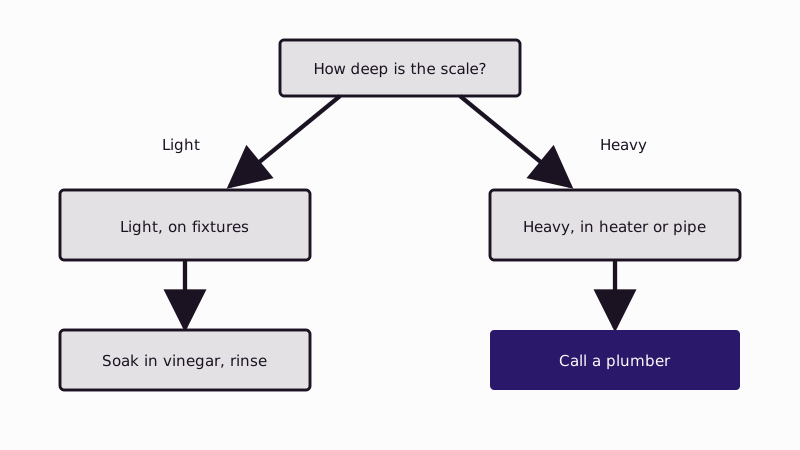
Heavy scale inside a water heater, dishwasher or pipe is a different job. A heater that rumbles, takes longer to heat or trips on temperature may have a scaled element or a sediment bed. That is a service visit. If a pipe has narrowed, low pressure may follow.
Do anti-scale conditioners work, and what about a softener?
A salt-regenerated softener swaps out calcium and magnesium in exchange for sodium, which protects the pipes behind it. Salt-free anti-scale conditioners claim to change how the mineral forms instead of removing it, and results are reported unevenly. Ask any seller for independent test data, not only a brochure, and ask your city whether it restricts salt-regenerating units.
Santa Monica already runs reverse osmosis on its groundwater, so many homes there will see a moderate number rather than an extreme one. A softener may still make sense for a house with a tankless heater, a large family or a lot of glass. For the cost side, see the water softener cost guide and the installation walkthrough.
A written quote should list the device, the brine or media, drain connections and the permit position. Contractor licensing in California starts once a job hits $1,000, so ask for that list in writing from the quote form.
How can I measure my own water hardness?
Buy a test strip or a drop-count kit and compare the result with your utility's published figure. Strips give a rough band, and drop kits count how many drops of reagent turn the sample, which converts to grains. A lab test is the only route to a precise number, and a plumber can arrange one if equipment is being sized.
Do the test on cold water from a tap that bypasses any existing softener, and repeat it a few weeks apart, since the blend changes. Write the results down: they make the quote conversation shorter, and they show whether a softener or conditioner is really helping afterward.
Common questions
Is drinking scale-forming water a health problem?
In USGS terms, hardness is a nuisance and not a health hazard. The damage lands on appliances, fixtures, soap use and glassware. Anyone told to watch sodium or minerals should ask a doctor before choosing a softener, because salt-based units add sodium.
Which grain setting suits my household?
No single setting fits every household. The city's average is about 9.4 grains, but sizing follows household water use more than a headline figure. Expect a plumber to work from the report, the head count and the number of bathrooms in the house.
Can scale damage a tankless heater?
It can. Mineral builds up inside the heat exchanger and cuts efficiency over time, so owners either treat the water or book descaling. Follow the maker's service notes and raise descaling when you pick equipment. Other services sit behind the home page.
Sources used
Page updated