Westwood is a renter's and condo owner's neighborhood. Wikipedia reports that 64.1 percent of its housing stock was renter-occupied in 2000 data, the eastern end of Wilshire Boulevard is lined with condominium towers, and North Westwood Village is mostly apartments near UCLA. For plumbing, that means the opening question is often "whose pipe is this?" rather than "what has failed?" The areas page places Westwood among its neighbors, and a job begins at the quote form.
When a Westwood apartment or condo leaks, who is responsible for the repair?
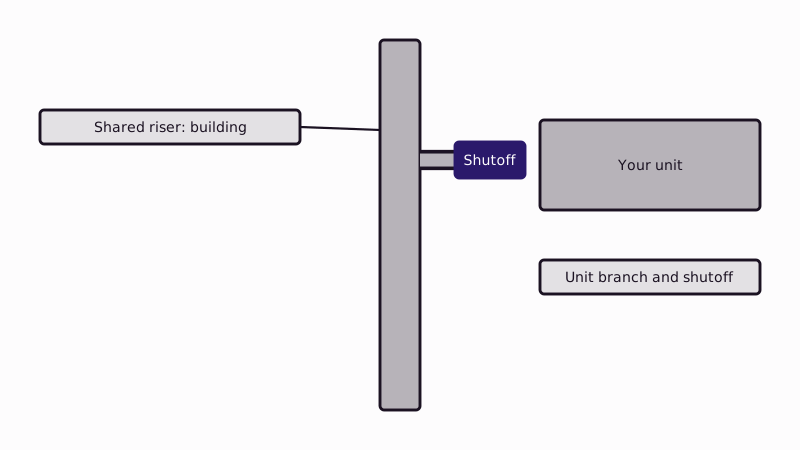
Responsibility follows the pipe's location, then the lease or the building's governing rules. Lines serving only your unit are usually yours or your landlord's to fix. Shared risers, stacks and the building's main belong to the association or owner. If the source is unclear, tell the manager first, then arrange a plumber to find out.
Water travels, so a leak in one unit often appears as a stain downstairs. Our pages on ceiling water leaks and on ceiling spots with no obvious leak cover how to trace the source and when condensation is the culprit. For active leaks, plumbing for leaks lays out the steps. If you can get to your unit's shutoff, close it, and put the report to management in writing so a record exists.
For insurance and who pays, rely on your lease, your association's rules and your policy. We do not give legal or insurance advice, and a written account of the cause from the plumber helps whoever has to decide.
What is Westwood's housing like, and how old are the pipes?
Westwood Village began developing in 1929 and kept growing through the 1930s, and UCLA opened for classes in September 1929. So parts of the neighborhood are nearly a century old, while the Wilshire towers and many apartment blocks came in later decades. Older buildings often hold original lines inside walls that cannot be opened cheaply.
The Wikipedia entry describes Westwood as a mix of multifamily housing and single-family homes. Holmby Hills, partly in Westwood, has larger houses. The north side near campus is mostly apartments where many UCLA students live, and Westwood Village is the shopping, dining and entertainment district just south of the campus.
What that means in practice: you may find galvanized or copper risers, cast iron stacks, and hot water systems shared between units. Plumbers in these buildings spend as much time on access and coordination as on the pipe. An unexplained cold shower may trace back to a building recirculation problem rather than your own faucet, and why the hot water stops helps you separate the two.
What should a Village restaurant or shop owner plan for?
Commercial tenants in the Village face drain and grease issues, shared sewer laterals and landlord approval for changes. Commercial water lines often carry backflow devices that need periodic testing, so ask your landlord who holds the records. For urgent trouble outside business hours, see emergency commercial plumbing.
Check your lease before authorizing any repair that touches a shared line. A grease-clogged drain may belong to the tenant, while a failed lateral under the sidewalk may belong to the owner.
Which water supplier and permit office apply in Westwood?
Everything in Westwood answers to the City of Los Angeles, with LADWP supplying water and LADBS issuing permits. LADWP's 2024 report lists Westwood among Western Los Angeles communities, fed by the Los Angeles Aqueduct and State Water Project imports. Its hardness table shows 112 mg/L and 148 mg/L for the two source plants that feed the area, moderately hard water.
On a gas heater in a house, LADBS's published position is that a permit is usually needed, and the carve-out is small and applies to contractors on the city's register. Condo towers and apartment buildings are different: the building's management usually arranges permits for common equipment, and large central systems carry their own requirements. State law, in the form of HSC 19211, also wants each tank restrained against quake shaking. The water heater permit guide lists questions worth asking a contractor.
Westwood sits at about 338 feet, with Beverly Hills along its eastern edge, where a different city and a different water system take over.
How does a plumber visit work inside a managed building?
Give three details when you write: the unit number, any building rules on contractor hours, and whether the manager must be warned. Many towers ask for advance notice, proof of the contractor's insurance or use of a service elevator. We will arrange the visit around those rules where they exist, since arriving without them can mean a turned-away plumber.
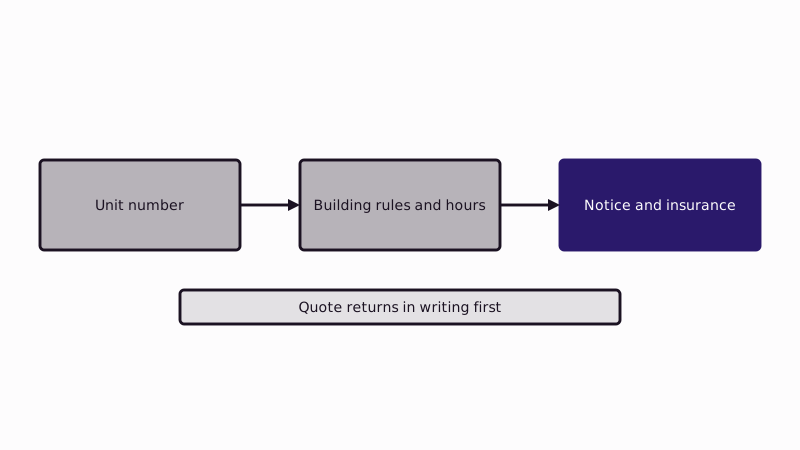
Those details go into the quote form, and the price returns in writing before any plan is final. The Sunset Coast home page shows what else we arrange.
Common questions
Who pays when water comes through from the unit above?
The owner or association responsible for the source pipe, as set by your lease or building rules. Start by telling the manager in writing. Taking photos of the damage and the date helps. Locating and documenting the source is plumber's work, and leak repair information describes the visit.
Does Westwood have hard water?
Moderately, going by LADWP's published figures. LADWP's latest table gives total hardness of 112 mg/L from the Aqueduct filtration plant and 148 mg/L from the MWD Jensen plant, about 6.5 to 8.7 grains per gallon. Expect mineral spots on glass and light scale in kettles and heaters. It is not extreme by Southern California standards.
Can a tenant order plumbing repairs in a Westwood apartment?
Normally the landlord decides who does repairs, so tenants should report problems rather than hire someone on their own. Telling the manager in writing creates a record. Duties around heat and hot water are covered in rental hot water law.
Sources used
Page updated