Does this page cover Bend, Oregon?
It does not. Sunset Coast Plumbing arranges work in Santa Monica and the Westside of Los Angeles County, so nobody here can visit a Bend property, and we have not looked at how the City of Bend or Oregon runs its program. If your address is in Bend, ring the water provider that bills you and ask who may test, how often, and where the report is filed.
Everything below describes California. Tester credentials, forms and deadlines change with the state and with the water utility, so the notice your own utility mailed outranks any web page, this one included. General code and inspection background sits on the permits and inspections page.
Why bother testing a device that sits there doing nothing?
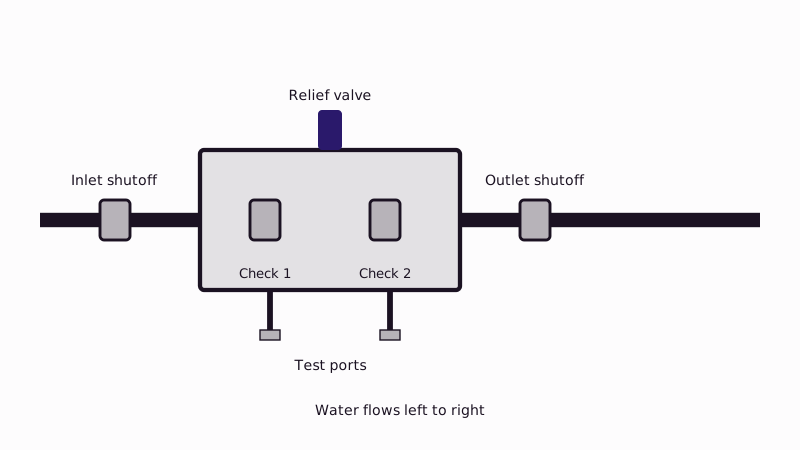
The assembly is a stack of valves that keep water in your pipes from flowing backward into the street main. LA County Public Works explains the trigger: a sudden pressure change, such as a main break or a hydrant being opened, can drag contaminated water into clean lines. Springs and rubber seats wear, so measuring is the only proof it still holds.
Picture a one-way door for water. Irrigation systems, pools, fire sprinklers and businesses that handle chemicals are the usual installations. If a worn device lets fertilizer or pool water creep toward the supply, neighbors on the same main can be affected. That is why this is a compliance item with a deadline, not a nice-to-have.
How often must it be tested in Santa Monica and nearby?
Yearly, with an additional test whenever an assembly is installed, repaired or moved. California's rules ask for annual testing by a state-credentialed tester, according to the county water district's program page, and a water provider may demand more. Your supplier's notice sets the due date, which is why it pays to keep the mailing.
Which utility you have changes the paperwork. Santa Monica supplies its own water through its Water Resources Division, so ask the city which notice and form apply to your address. Parts of Malibu are served by LA County Waterworks, which mails a form each year that the customer must schedule and return. Parts of the Westside that sit within City of Los Angeles limits take water from LADWP. We have not confirmed each one's current deadline.
Who can legally perform the test?
Only a tester approved through the County Department of Public Health can do it, and LA County Public Works says the department publishes the list. A plumber who is not on it cannot sign off your report, even if they handle every other plumbing job at the property. Ask to see the tester's credential number and which agency the report goes to.
Repairing or replacing the assembly is a different job, and it belongs to a plumbing contractor, classed C-36 by the state board. Under California law contractor licensing starts at $1,000 of work. Request the scope and the figure on paper, using the quote form, before a valve gets touched.
What does the test involve, and what does it take out of your day?
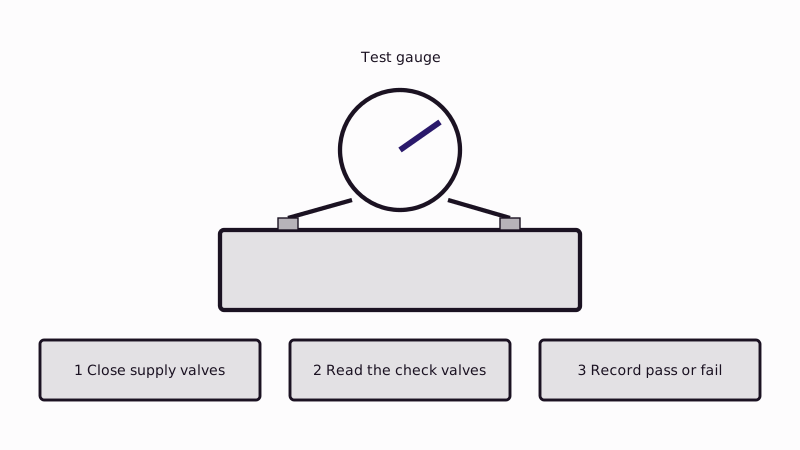
The usual routine: close the supply to the device, connect a test gauge at the ports, then read pressures at the first and second check valves and at the relief valve. A test is usually a short visit, and the tester will give you an estimate. Add time to complete the form. Water to the property is off for part of that.
Give people a heads-up before the visit, especially anyone mid-laundry or running irrigation. Have the box or cage that holds the device unlocked and clear of mulch, vines and standing water. Hidden or flooded assemblies are the usual reason a short job turns long.
What will the test itself set me back?
LA County's program page calls roughly $75 to $150 per device typical. That is one county's guide rather than a price for your property, and only a written quote fixes the real amount. Extra devices, awkward access and travel raise it. Backflow device testing cost goes deeper into what moves the number.
Repairs are priced separately. Worn rubber parts and springs are routine replacements, while swapping a whole assembly costs much more than a re-test. Ask whether the quote includes a re-test after repairs, because a failed unit generally needs a passing report on file.
What happens when an assembly fails?
Repair or replacement comes first, then a fresh test by a credentialed tester, then the passing report goes to the water provider. The county warns that missing reports can bring a shut-off notice and, ultimately, loss of service. Get the failed readings in writing so the repair can be targeted.
Many failures are fixed with a service kit that refreshes seals and springs. A corroded or wrong-type unit may be better replaced, and that step brings in a contractor and, depending on the city, a permit. Ask the city's building office what your scope requires.
Which properties on the Westside usually have a device?
Check for a sprinkler-fed lawn, a fire sprinkler line, a pool or spa fill, a restaurant kitchen, or a business that works with chemicals. A plain house without irrigation often has none, though the utility's records decide. A metal tag on the device, or last year's mailed notice, will confirm what you have.
Business owners should read about commercial backflow testing. The sequence is detailed in how backflow testing is done, with the wider picture on backflow prevention testing. Everything else we line up is on the home page, and coastal readers can see the Malibu page.
Common questions
May an owner run the test personally?
No. A test counts only when a credentialed tester performs it and files the result. You can help by keeping the device reachable and the tag legible. Repairs go to a plumbing contractor, and the filed report goes to your water supplier.
Does Oregon test the same way?
We do not work in Oregon and have not checked its rules. Plenty of states ask for annual checks by a qualified tester, but forms, fees and deadlines vary widely. Phone the water supplier for the Bend address and ask who tests, how often and where results are sent.
Is a gas smell during the visit part of the test?
Treat that as its own emergency and go outside. SoCalGas can be reached on 1-800-427-2200, with 911 for anyone in danger. Stay out of the building until the utility says it is safe to return, whatever the test schedule says, and let the tester know why the visit stopped.
Sources used
Page updated