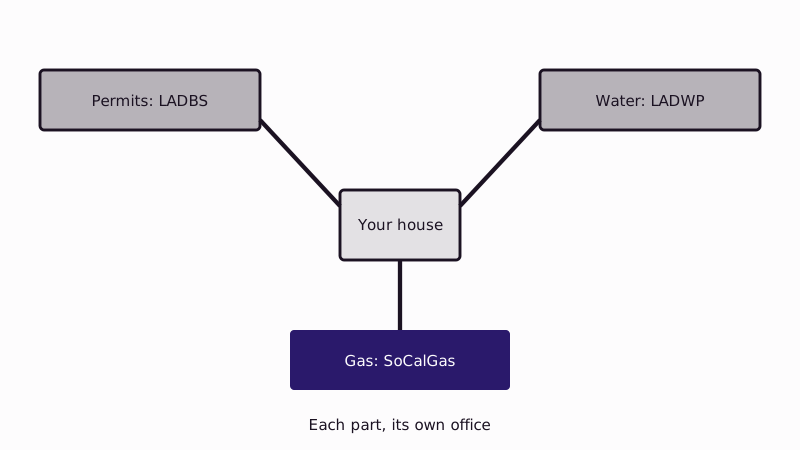
When the Palisades Fire ran from January 7 to January 31, 2025, it destroyed 6,831 structures, and that leaves plumbing here split two ways: new houses going up beside older ones that survived. Each needs different attention. This page covers what rebuild plumbing involves, what is different about the older streets, and how to book. The wider region is covered on the areas page; the quote form takes details directly.
What does plumbing look like on a Palisades rebuild?
A rebuild starts with permits and ends with inspected pipe. City of Los Angeles jurisdiction applies here, which means rebuild applications run through LADBS and City Planning, and water reconnection goes through your water provider, so confirm with it. Plumbing permits are issued per job, so one house can generate several.
Ordinance 188985 waives permitting and clearance fees for rebuilds up to 110 percent of the destroyed structure's size, including plumbing permit fees, per reporting by Palisades News. State charges still apply. Fee rules shift over time, so ask LADBS before you budget. Whoever prices the job should tell you who files the permit.
Typical rough-in decisions on a new house include supply material, water heater type and where a shutoff goes. Reading PEX versus copper and tank versus tankless heaters helps before the design is fixed.
What about the older homes that survived?
The Alphabet Streets were the first neighborhood built, starting in 1921, with the smallest lots in the Palisades, between 5,200 and 7,500 square feet. Homes from that period may still have original galvanized steel water lines and sewer runs of cast iron or clay, unless a past owner replaced them.
Heat and smoke exposure may not show on the outside of a survivor. If a house stood through the fire, ask a plumber to check for pressure drops, discolored water or odors, since damaged or stressed lines can fail later. No source I read quantifies fire-related plumbing failure, so this is a reason to inspect rather than a prediction.
For old supply pipe, read galvanized pipe replacement. Grey plastic supply pipe from the late 1970s onward is a separate worry, and polybutylene replacement is the place to read about it.
How do bluffs, canyons and elevation affect the pipes?
The neighborhood runs from sea level to about 2,126 feet, with canyons named Temescal, Potrero, Santa Ynez and Rustic, and Santa Monica Canyon. That range of elevation means incoming water pressure can differ sharply from one street to the next.
Homes in the Palisades Highlands, which sit in Santa Ynez Canyon, and lots on a bluff may need a pressure regulator, expansion tank or booster, depending on where they sit relative to the supply. A regulator sets the pressure at the house; see how to adjust one and what installing a regulator costs.
Slopes also put drain lines under stress: a pipe laid on shifting ground can sag and hold water. Slow drains that return after clearing suggest a belly in the line, which a camera inspection would show.
Who supplies the water, and who regulates the work?
Los Angeles city government, not the county, covers Pacific Palisades, so LADBS issues the permits. LADWP's 2024 water quality report lists Pacific Palisades among its communities, but read your own bill to be certain who serves you. Hardness depends on the supply blend, so request your provider's latest quality report.
Your gas statement names the utility. For SoCalGas customers the number to ring is 1-800-427-2200, once everyone is outside; 911 covers danger. New gas piping is normally inspected under the permit before service is restored, which is part of the permit process rather than something to do yourself. What contractors handle is outlined on the gas line page.
Which jobs are best planned around the rebuild timeline?
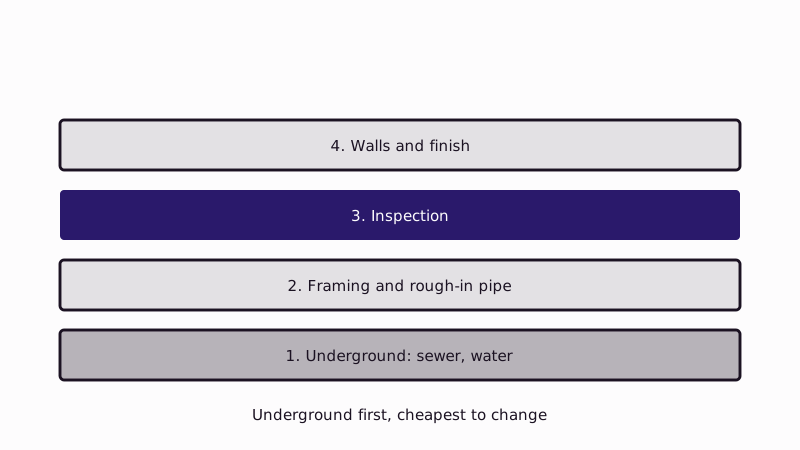
Wrap plumbing questions into the build sequence early. Underground work, such as sewer laterals and water service lines, is far cheaper to adjust before concrete goes down. Water shutoffs, backflow devices and seismic gas shutoff valves are easy to forget until final inspection.
Ask whoever quotes the work to list, in writing, every fixture and line the permit covers. On the valve, earthquake gas shutoff is worth a read; backflow prevention testing applies to devices that need periodic checks.
How do you set up a plumber visit in the Palisades?
Give the address, say whether it is a rebuild or a lived-in house, and describe the trouble. A local plumber is scheduled to visit, then the written quote follows, and no work begins until you approve it. We answer calls weekdays, 9am to 5pm.
Mention gate codes and parking: construction sites and narrow canyon streets often limit where a vehicle can stop. The full sequence is on how a job runs. Because rebuild scopes vary so much, no price appears here; what a plumber costs gives sourced general ranges.
Common questions
Do rebuild plumbing permits cost anything in Pacific Palisades?
Fees for plumbing permits are waived on qualifying fire rebuilds up to 110 percent of the lost structure's area under Ordinance 188985, while state charges remain. Terms may be updated, so verify with LADBS and ask your contractor exactly what the permit includes.
Can a surviving house have fire-related plumbing damage?
It can, even without visible damage. Heat can weaken plastic pipe and fittings, and some failures only appear months later. Watch for brown water, pressure changes or odors, and ask a plumber to inspect. We cannot say how likely it is for a given house without a visit.
What are plumbing costs like in the Palisades?
A repair, a rebuild and a repipe sit in different cost brackets, so we state no fixed figure for the Palisades. The plumber inspects the property first, then writes a quote that you can read before agreeing to any work. Sourced general ranges: water heater replacement and whole-house repiping.
For the bigger picture, start from the plumber guide for Santa Monica.
Sources used
Page updated