For commercial work in the Los Angeles area, one Los Angeles plumbing company's published guide puts daytime commercial labor at $110 to $225 per hour, with overtime billed at one and a half to two times the standard rate. Consider them a guide, never a quote. Below you will see where a rate comes from, how master and journeyman pricing differs, and what a finished bill looks like. For urgent calls, go to the emergency commercial plumber page.
If you run a restaurant, office, retail unit or apartment building in Santa Monica and the Westside, the real question is rarely the hourly rate alone. It is hours on the job, the extras added to labor, and who answers if the fix fails.
What is the going commercial rate near Santa Monica?
That Los Angeles guide puts daytime commercial labor between $110 and $225 per hour and lists commercial service calls at $500 to $1,000 or more. Residential work in the same guide is cheaper, from $85 to $130 hourly for a journeyman plumber.
Two things set the commercial rate higher than a home rate: a more experienced plumber is often sent, and the work carries commercial insurance, permits and sometimes backflow-test paperwork. The same guide lists the Los Angeles average service call at $375 to $450 against a national average near $339, so local labor and licensing costs run higher. Other guides publish different ranges, so ranges differ by source, and it is wise to ask for the actual rate on your own estimate.
Why is there a gap between a plumber's wage and the rate on your invoice?
Because the number on the invoice funds much more than one person's wage. Employer payroll costs, insurance, the truck, tools, permits, dispatch, warranty callbacks and downtime all sit inside it. A worker earning a median wage in California does not take that whole figure home from your hourly bill.
Your invoice rate lands well above what the plumber takes home because of the overhead items above: insurance, vehicles, tools, dispatch, permits and the time spent between jobs. A business that charges less than its overhead needs will cut corners somewhere, so the very lowest bid deserves questions.
How do master and journeyman rates compare?
Journeyman and master are trade terms for experience level. Expect a master or lead plumber near the upper end, with a journeyman or apprentice priced lower. Which one is sent should be stated in the estimate. The legal license in California is held by the contracting business, in the plumbing classification, not by each worker.
For a simple repair, a single mid-level plumber is enough and costs less per hour. For a complex job, such as a re-pipe of a restaurant kitchen, the contractor may send a lead and a helper, and you pay each rate for the time worked. Ask for a rate by role, not a blended number.
What pushes the rate up or down?
Time of day, access, the size of the job and the equipment needed are the biggest factors. The guide we read multiplies the standard rate by one and a half to three for emergency service, and lists extra charges for after-hours visits. Tight spaces, tall risers and old cast iron take more labor. A full day on site adds up quickly at these hourly rates.
Other cost drivers in a commercial building:
- Equipment. Jetting machines, drain cameras and pumps are often billed separately.
- Permits and inspections. New lines, water heaters and backflow work may need city permits, and fees pass through to you. The yearly commercial backflow test is a typical fixed-price item.
- Material grade. Commercial fixtures and pipe often cost more than residential.
- Access and after-hours work. A restaurant that must stay open may require night work.
What does a sample bill look like?
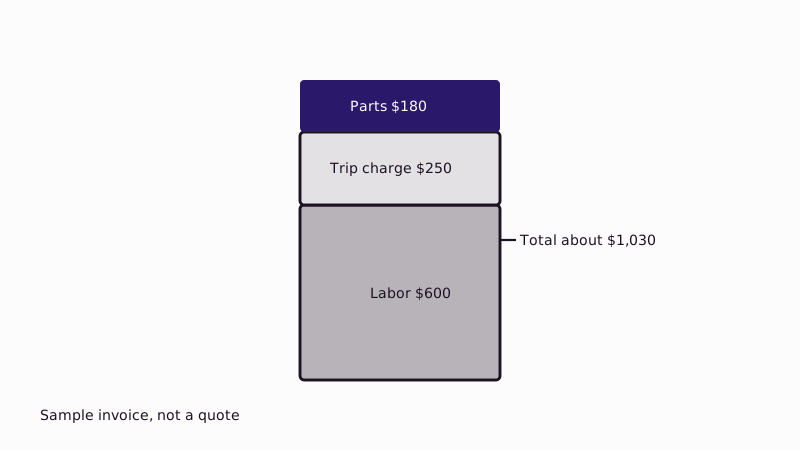
Take a four-hour weekday repair. Labor is the hourly rate times four hours. Add the trip charge, then the parts, then tax. Move the same repair to midnight and the hourly rate rises, a minimum charge may apply, and the total jumps. Ask the plumber to write out each of those lines with real figures in your own quote.
Use this to build a quick calculator:
- Hourly rate multiplied by estimated hours, with the rate by role.
- Plus the trip or minimum charge, if any.
- Plus parts and materials, which should be itemized.
- Plus equipment charges, such as a camera or jetter.
- Plus permit fees, if the work needs a permit.
If the estimate cannot be filled in this way, ask for the missing lines.
How should you compare quotes from different plumbers?
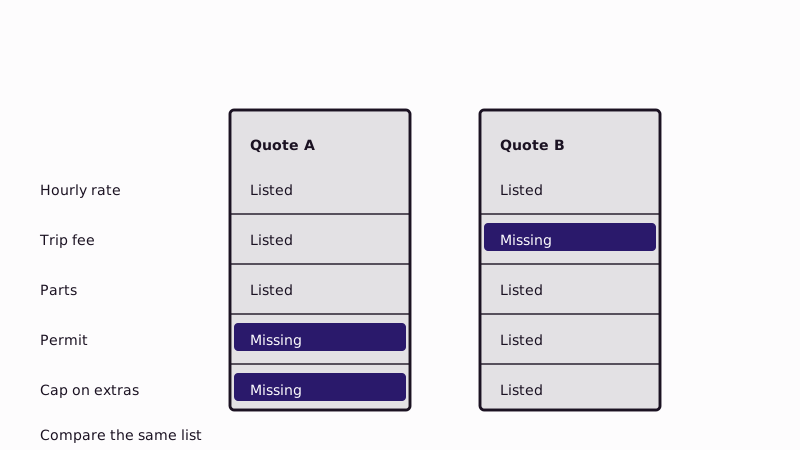
Compare the total scope, not just the hourly rate. A cheap rate stretched over extra hours can end up above a pricier rate that finishes fast. Put each quote on the same list: hours, trip fee, parts, equipment, permits and what happens if the job runs over. Then compare the totals.
Questions that make quotes comparable:
- Is the price fixed or hourly, and is there a cap before they call you?
- Is there a minimum, and does the first hour have to be paid in full?
- Is travel time charged?
- Who handles the permit?
- Can they provide a certificate of insurance for your landlord?
State law demands a contractor license for work above $1,000, and the licensing board's online lookup shows status and complaints. On larger jobs, request the scope on paper. The plumber cost guide covers home pricing if you also manage residential units, and the inspection cost guide shows what a camera inspection adds.
Common questions
What is a reasonable hourly rate for a plumber?
By that Los Angeles guide, reasonable means roughly $85 to $130 per hour for a journeyman at a home and $110 to $225 in a business, per one Los Angeles guide, with premium rates after hours. Reasonable also means a clear estimate, the right license and insurance, and a quoted total that matches the scope, not just a low number.
Why do plumbers charge a minimum or trip fee?
The trip fee covers driving, dispatch and the time it takes to arrive and diagnose, even when the repair is short. One Los Angeles guide lists a trip or dispatch fee of $75 to $200 for homes, waived if the work goes ahead, and commercial service calls from $500. Check if the trip fee gets credited toward the repair, and if the opening hour is billed whole.
How do rates change in 2026 compared with 2022?
Rates have generally risen with wages, insurance and material costs, so a 2022 figure is likely lower than today's. The numbers on this page come from prices checked in November 2026. Lean on your own written estimate, because every firm and job type prices differently.
Is a flat price better than an hourly rate?
A set price removes surprises when the scope is obvious, like swapping a water heater. Hourly billing fits a hunt for an unknown fault, like tracing a leak. If you pick hourly, ask for a cap above which the plumber must call you before continuing.
Prices are one part of the job: plumber santa monica covers the rest.
Sources used
Page updated