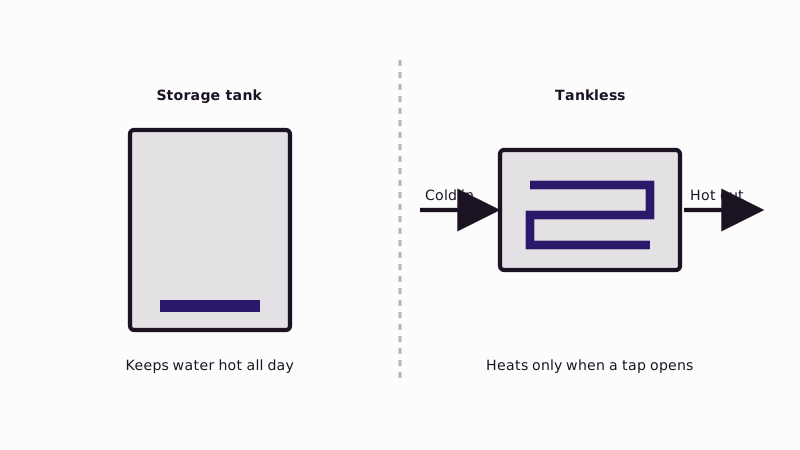
Light use, a gas line that already runs to a wall near the heater, and a plan to stay a decade or more: tankless usually wins. A big family, a tight closet, an old electrical panel or a short stay: a storage tank usually wins. Below we compare cost, lifespan, running cost, gas and electric limits, and what the swap involves. Not sure which side you are on? The water heater service page explains how a visit and a priced sheet of paper work.
What does a tankless heater cost next to a tank?
Bob Vila's national guide puts the typical storage tank around $1,000 and the typical tankless unit around $2,500. Moving a house off a tank can add as much as $2,500 in labor for venting, larger gas pipe or electrical work. Your own paper quote, not a national average, sets the bill.
Buyers tend to miss the conversion gap. A new tank drops onto the pipes and flue that served the old one. A wall-hung tankless unit wants a fresh vent route, gas pipe sized for a much larger burst of fuel, and, on condensing gas models, a drain for acidic condensate. Electric tankless units draw heavy amperage that many older Westside panels cannot spare.
Add permits ($25 to $300 in that guide) and hauling away the old tank ($100 to $500). None of this is a Santa Monica rate card. For the whole bill line by line, open replacement costs; for the pricier unit by itself, open tankless installation pricing.
Which one is cheaper to run, gas or electric?
Light users gain the most. Energy Department figures show a demand-type heater cutting consumption somewhere between 24 and 34 percent in a light-use home (up to 41 gallons a day), and by just 8 to 14 percent near 86 gallons. Family size matters more than brand.
The saving comes from skipping standby loss, the heat a tank bleeds through its walls while nobody is showering. Nothing else. And the DOE itself warns that real results swing with how much water the household draws.
Fuel changes the picture in three ways:
- Gas against gas: tankless usually wins on running cost, provided the gas line and flue can be upgraded without opening walls.
- Electric against electric: both turn almost all power into heat, so the gain is limited to the lost standby heat, and a panel upgrade can swallow it.
- Propane: a canyon or hillside lot on a propane tank burns less fuel with tankless, but propane is priced differently from utility gas, so get the comparison in writing.
Does a mini tank count as tankless?
No. A mini tank is a compact storage vessel feeding one sink or one far corner, while tankless means no stored water whatsoever. Mini tanks fix a long wait at a distant faucet. They do not replace the main heater.
Picture a kitchen at the back of a Craftsman, or a guest suite built above a garage. A small point-of-use heater helps there. So does a recirculating pump on the existing line, which moves hot water to every fixture without a second appliance. If the wait is your complaint, ask for both options priced.
Will a tankless unit fit an older Westside house?
Often yes, after some changes. Mid-century houses in Culver City and Westwood typically keep the tank in a garage or closet on a flue, fed by a modest gas line. A tankless gas unit needs larger gas pipe plus a new vent route, and an electric one needs its own heavy circuit, which an old panel may not offer.
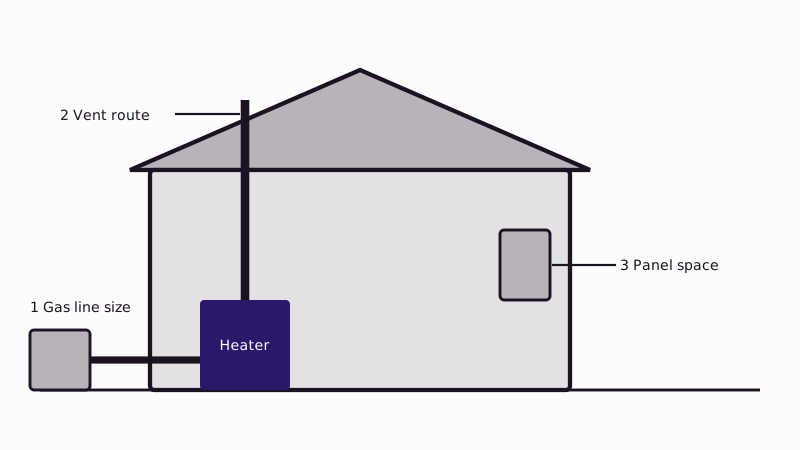
Three questions settle it. Can the gas meter and pipe deliver the bigger flow? Is there a clear route through a wall or roof for the vent? Does the panel have spare capacity? The visit answers all three. Condo owners also need the building's approval before touching a vent or shared wall.
Hillside and coastal houses add two twists. Salt air can shorten the life of exposed steel fittings, so ask about stainless or coated parts near the water. Steep lots make long vent and gas runs expensive. Neither is a reason to skip tankless; both belong in the written quote.
Which type outlives the other, and what fails first?
Expect a tank to serve roughly 10 to 15 years (Bob Vila also quotes 8 to 12 for basic units) and tankless closer to 20. Warranty terms vary by model, so read the one on your unit. Tanks die of rust from the inside; tankless units die of scale on the heat exchanger, so a yearly flush is the main upkeep cost.
Repairs differ too. A tank usually needs a new pilot assembly, thermostat, element, anode or relief valve, and Fixr's national figures for those jobs run from $75 to $750. A tankless unit shows an error code and often calls for a specialist with the right diagnostic tools. The tankless gas water heater repair guide walks through it.
Hard water accelerates scale in either type. Check the hardness figure on the annual report from whoever supplies your water before picking a flush schedule or a softener.
Will Santa Monica ask for paperwork before the swap?
The short version is yes. Santa Monica lists hot water heater change-outs under its Single Trade Construction Permit, and that permit comes with up to three inspection visits. The person who reconnects the gas needs the matching license from the state, so even a handy homeowner stops before that step.
Two state rules help you here. State rules worth knowing: the exemption from holding a contractor license ends at $1,000 in total job value (the 2025 threshold). Deposit ceiling for home improvement work: whichever is smaller, $1,000 or a tenth of the price. The board's website verifies any license number.
Rotten-egg odor ends every conversation. Everyone goes outside first. Out there, report it to SoCalGas at 1-800-427-2200, and save 911 for injuries or dizziness. Do not relight or reconnect anything yourself. Forms and fees are explained in the permit write-up for water heaters.
Is a heat pump the third option?
A heat pump water heater is a storage tank topped with a compressor that pulls heat out of the surrounding air. It needs floor space and airflow, and it cools the room it sits in. A roomy garage suits it far better than a hall closet.
This page prices only tank and tankless, because we have no sourced figure for heat pump units. If you have the space and panel capacity, ask for that option on the quote. Rebates change often, so confirm current terms with the program itself.
Which should you pick?
Choose a tank for a big household, a cramped utility space or a tight budget this month. Choose tankless for light to moderate use, a long stay and a house where gas, vent and panel cope without major construction. Torn between the two? Ask for both on one written quote.
Common questions
How far apart are the two on installation day?
In Bob Vila's national guide a tank runs about $1,000 and a tankless unit about $2,500, and converting a house can add up to $2,500 of labor. What drives the spread is venting, gas pipe size and panel capacity. Your address gets its own figure after a plumber inspects the setup and writes it down.
What does a tankless water heater repair involve?
Most tankless heaters flash a fault code first. Behind it you will often find scale, a sensor, ignition or a blocked vent. A flush solves some; others need a specialist. Keep out of the gas side. A local plumber comes, diagnoses, and prices the repair next to a replacement.
Is a tankless heater worth it for a small household?
Frequently, since the Department of Energy sees a 24 to 34 percent gain at low usage. The catch is the extra install cost: heavy venting and gas work stretch the payback. Have both options priced, then weigh them against how long you plan to live there.
Does propane change the comparison?
A propane tankless unit still burns less than a propane tank, yet propane is bought by the gallon at its own price, and the burner must be configured for it. Hillside lots use it more than flat blocks. Where both fuels are possible, ask for them priced side by side.
Can I install either type myself?
Not the gas models, and not anything needing a permit. Santa Monica wants one for a change-out, the gas hookup belongs to a license holder, and a sloppy vent or relief valve joint is a real hazard. Flushing and watching the unit is the part left for you.
Both units priced for your own address? Open the quote request and someone local visits to look at the setup. Everything else on the site starts from the Sunset Coast Plumbing home page.
Sources used
Page updated