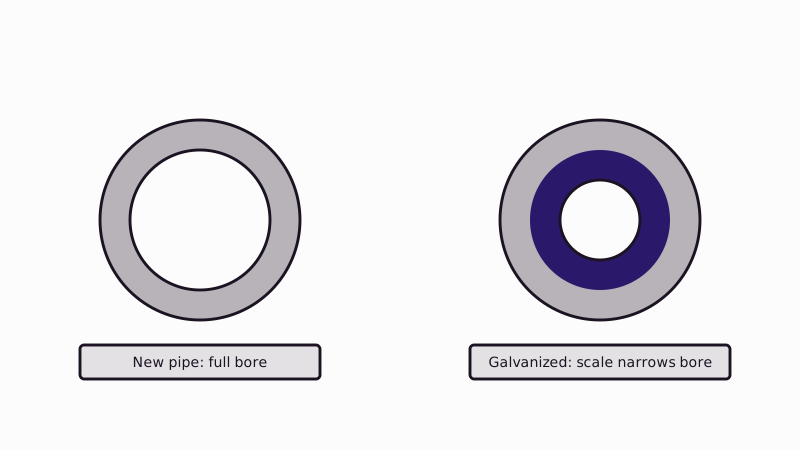
Zinc-coated steel looks permanent, but the coating is a countdown clock. When it thins, rust builds from within the pipe wall until the opening chokes or a threaded joint gives way. On the Westside, a house older than the 1960s has either been repiped or still hides some of it. When brown water, sagging pressure and repeat leaks arrive together, the whole run should go. A full overview of the job sits under repiping a house, and this page narrows to the galvanized case.
Is that gray steel pipe galvanized?
Check any pipe you can see, in the garage, by the heater or under a sink. Galvanized steel is dull gray, screwed together at threaded fittings, and it grabs a magnet. Copper is orange-brown; PEX is red, blue or white plastic. A key scratched through the rust exposes silver-gray metal.
Age is the second hint. Builders used galvanized supply lines until around mid-century, so a 1920s Craftsman, a 1930s Spanish Revival or a 1950s ranch in Santa Monica, Culver City or Westwood may have them unless a past owner repiped, often only in part. Patchwork is common, with copper from one bathroom remodel and galvanized in the wall behind it. A plumber can find where the two meet, usually at a dielectric fitting or a crude brass union.
What are the signs that galvanized pipe is failing?
Five classic signs: orange-brown water at first draw, weak pressure at faucets and showers, flaking at threaded joints, small leaks that come back after repair, and a metallic taste. Rust shrinks the pipe's bore, so pressure drops even though the street supply is fine.
Try a comparison: flow from the hose bib closest to the main against flow from the farthest bathroom. A big difference suggests the interior pipe is constricted, not the street supply. Another sign is a pinhole repair that holds for a month and then another appears a foot away, which is the pipe telling you the whole length is thin. A pressure drop that comes on suddenly is a different matter, covered in sudden low pressure.
What does a repipe replace the galvanized with: PEX or copper?
Both are accepted. Many owners choose PEX for speed and price, and copper for its long record and solid feel. PEX is flexible tubing that snakes through walls with fewer joints. Copper gets soldered, which takes more labor and money, but it shrugs off fire and sunlight.
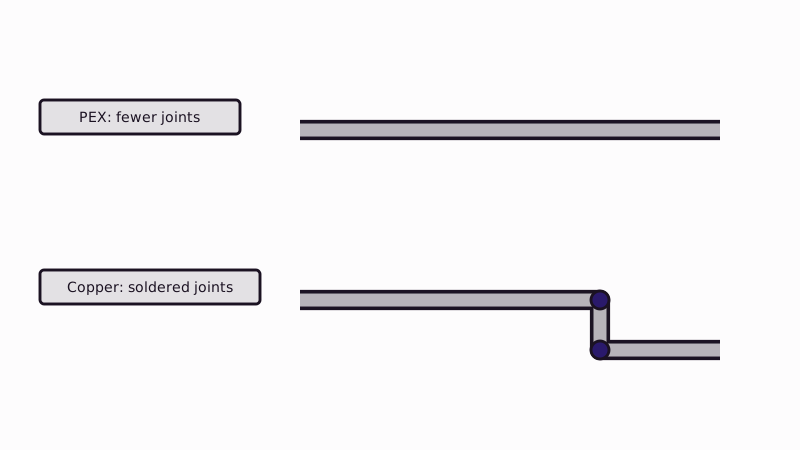
Local conditions affect the pick. Santa Monica's supply reads about 160 parts per million hardness in the latest city reports, and copper can pit in some water chemistries. PEX doesn't rust or scale, but it has to stay out of sunlight and away from some solvents. If a house is on a slope, flexible PEX can follow the framing better than rigid copper. For the full comparison, read PEX versus copper before you collect quotes.
How many days does repiping take?
A PEX job usually means one to three days of plumbing in an average home, and copper may need three to seven because of the soldering. Counting inspection and drywall patching, estimates run from about three days to two weeks, longer for big homes with many bathrooms.
Water is generally off only during working hours and restored in the evening, so most families can stay, with a plan for showers and laundry. Walls open at the fixtures, so patching belongs in the schedule and paint usually does not. An inspector who must approve the rough-in before walls close adds a visit. Request an outline of each day beforehand.
Does a Santa Monica repipe need a permit?
Yes, in practice. The City of Santa Monica's homeowner permit guide lists plumbing work, including re-piping, under a single-trade permit, and the municipal code exempts only clearing stoppages and leak repairs that do not replace pipes, valves or fixtures. A whole-house repipe replaces pipes, so it falls outside that exemption.
The plumber normally files the permit paperwork and books the inspection. Westside addresses answer to different offices: Los Angeles city for Brentwood, Venice, Westwood and Pacific Palisades, Culver City, Beverly Hills and West Hollywood for their own, and Los Angeles County for Malibu, each with its own forms and fees. Any repipe clears California's $1,000 contractor license trigger by a wide margin, and deposits are capped at ten percent or $1,000, whichever is lower. Verify the license online before signing.
Is there a polybutylene pipe replacement program?
Not any more. Polybutylene, a gray plastic pipe laid in homes between the late 1970s and the 1990s, was covered by the Cox class action settlement. Celanese's filings state that the claims period expired and the administrator was dissolved in 2010, so replacement now falls on the homeowner.
Gray plastic supply lines with copper or plastic fittings should be mentioned when you collect quotes, since insurers sometimes raise premiums or decline coverage on such homes. The remedy is the repipe described here; polybutylene pipe replacement covers that material. On the Westside it shows up in newer tracts and condo conversions more than in older bungalows, which lean galvanized.
What will it cost, and is it worth doing before a leak?
Published guides put a 1,500 square foot whole-house repipe near $4,000 to $11,000 in PEX and $8,000 to $22,000 in copper; labor is the bulk. Copper costs more than PEX. Acting before a leak avoids water damage and lets you plan the wall repair.
House size, bathroom count, stories, foundation type and the amount of opened drywall set the price. Slab houses, common in Venice and Marina del Rey, are priced differently because the plumber may route lines through the attic rather than break concrete. Figures and drivers are broken out in galvanized pipe replacement cost and repipe cost; older houses get extra context in what an old house's plumbing replacement involves.
Common questions
Is galvanized pipe water safe to drink?
Rust itself is mostly an appearance, taste and pressure issue, but it can carry sediment that clogs fixtures. If the line has any lead component, such as an old service connection or solder, that is a separate health matter to raise with your water supplier, and a plumber can help identify materials. Brown water is a reason to get the pipes looked at.
Can only one section be swapped out?
Yes, as a stopgap. Fresh pipe tied to old galvanized can corrode where they meet unless a proper transition fitting is used, and the rest keeps aging. When leaks are limited to one stretch and the remainder is sound, partial work can make sense. Have the plumber look at the whole line first.
How many days for a two-story house?
Expect three to five working days for PEX, plus inspection and patching, and a week or more with copper. Access decides: crawl spaces and attics help, finished walls hurt. Any schedule should state in writing when the water is off and when the inspection happens.
Will insurance cover the repipe?
Generally no, because a repipe is replacing worn pipe, not repairing sudden damage. If a covered burst causes damage, the cleanup may be covered even though the pipe is not. Read the policy and ask your agent before you start. Some carriers also ask about pipe type when you renew.
How can I vet who I hire?
The state's contractor board runs an online lookup for licenses and complaint records. Insist on a written contract, hold any deposit to the legal cap and confirm who pulls the permit. Gather at least two written quotes to compare, and check each contractor against the lookup before you choose.
Browse everything else on the Sunset Coast Plumbing home page.
Sources used
- City of Santa Monica, Homeowner's Guide to permits (plumbing and re-piping under single-trade permit)
- City of Santa Monica Municipal Code 8.08.050, permits required
- Celanese Corporation SEC filings on the Cox polybutylene settlement (claims period expired, administrator dissolved 2010)
- Costto.build, house repiping cost
- Nearby Hunt, cost to repipe a house
- California Contractors State License Board, hiring a contractor
Page updated