Usually yes when a pipe suddenly splits, usually no when it dripped for weeks. California's insurance regulator puts abrupt, unintended water damage on its list of covered perils, and files seepage, leaks, wear and tear and mold under generally not covered. We run a plumbing service, not an insurance company, so your policy and your agent have the last word. The urgent part is plumbing: stop the water, then follow the leak and burst pipe guide.
Does the policy pay if a pipe bursts?
Typically yes, when the water damage is sudden and accidental. The state insurance department says homeowners policies usually cover that kind of loss, though not flood, and not damage that comes from seepage. Exact wording, deductible and exclusions in your own policy decide the outcome, so read it.
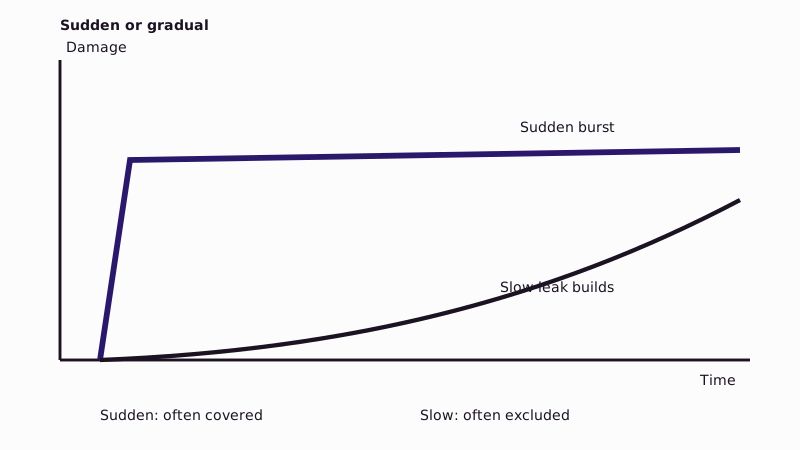
What counts as sudden? A supply line that splits overnight, a washing machine hose that lets go, a freeze crack. What counts as gradual? A pinhole that wept inside a wall for months and rotted the framing. The insurer asks how long water ran, and adjusters look for staining, rot or mineral crust that betrays age. The line between the two is the main reason claims are disputed, which is why the notes you take on day one matter.
What do policies tend to exclude?
The state's not-covered list includes seepage and leak damage, wear and tear or maintenance, mold, neglect, and a house left vacant for 60 days or more. Flood loss is generally not part of a homeowners or renters policy either; separate flood cover exists through a federal program.
Two consequences. The pipe itself, meaning the cost of replacing worn plumbing, may count as maintenance even when the water damage it caused is paid, and policies differ, so ask how yours treats the two. And a house left empty for two months is a bigger coverage risk than it sounds, which matters for owners who travel.
What comes first, in the first sixty minutes?
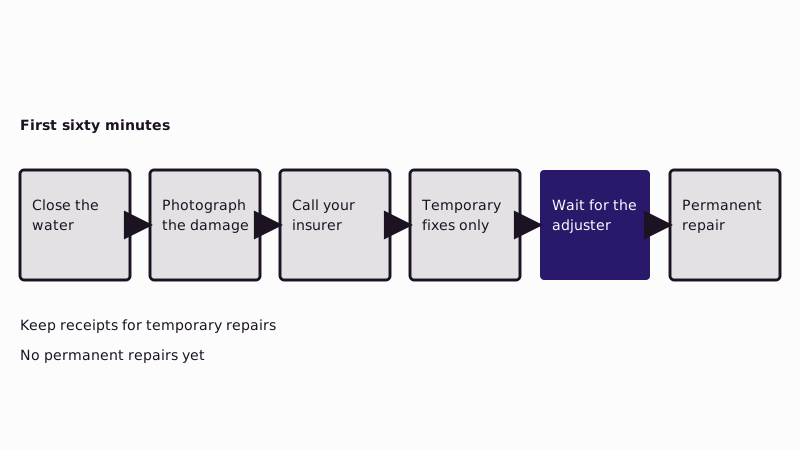
Close the water, record the damage and phone your insurer soon. In Santa Monica the property shutoff is usually on the side of the building, and the valve inside the meter box is the city's, so only city staff may touch it. Photograph everything before you move a thing.
Then limit the damage. The state's claims guide says to make temporary repairs to prevent further harm, such as covering openings, to save receipts, and to hold off on extensive permanent repairs until the adjuster has assessed the damage. If the area is unsafe, do not enter, especially around wet electrical outlets. Call a plumber for the emergency repair. What an emergency visit involves is on burst pipe emergency help, and the page on spotting a burst pipe is for the moments you are unsure.
What records strengthen a claim?
Hold on to pictures and video, the failed pipe section if the plumber can spare it, the written invoice, and a log of your calls with the insurer. The plumber's report should name where the pipe failed and what likely caused it, because the adjuster cares about cause.
The Department of Insurance also tells claimants to keep receipts for temporary repair materials, to get written line-item bids from contractors, and to complete the insurer's proof of loss form if it sends one. Ask the plumber to write what they found in plain terms: the pipe material, the age if known, the failure type and the location. A vague invoice reading "repaired leak" gives the adjuster nothing to work with. For a plain explanation of what a burst looks like inside a house, see burst water pipe in a house.
Is the cost of locating the leak covered?
Sometimes. A few policies pay to open and repair walls in order to reach a covered leak, and others do not, and detection charges are a separate question for your agent. Raise it before the work begins, and get an itemized estimate from the plumber.
For what detection typically costs, read plumber leak detection cost. For slab leaks, which carry their own coverage questions, see homeowners insurance and slab leak repair.
How can a denial be avoided?
Report early, act to stop the damage, document everything, and do not make permanent repairs until the adjuster has seen the loss. Keep the policy, and ask the insurer in writing for anything you do not understand. The state publishes a hotline for disputes.
If you disagree with a decision, the Department of Insurance advises talking to the claims manager, sending your documents, and calling its consumer hotline at 1-800-927-4357. Prevention counts too. A pipe that fails from age with no maintenance is the case insurers most readily call excluded, so replace old lines and check the pressure. Our burst pipe prevention page lists the checks worth doing every year.
Common questions
Does the insurer pay for the pipe or only the water damage?
Policies vary. Many pay for the water damage after a burst once the deductible is met, while the plumbing repair itself may be treated as maintenance. A few cover the cost of opening walls. Ask the insurer, in writing, ahead of the repair.
Is a slow leak covered?
Generally not. The Department of Insurance lists water damage from seepage or leaks among the perils typically not covered, along with wear and tear. If a slow leak turns sudden, such as a pipe that finally splits, the insurer will look at the cause and the timeline.
Could a claim push my premium up?
That depends on the insurer and your claim history, so we cannot say. Put the question to your agent before filing, and ask whether claiming makes sense at all when the repair bill sits close to the deductible. Get the answer in writing.
Plumber or insurer, which call comes first?
Stop the water, then ring both. The plumber fixes the pipe and writes the report, and the insurer opens the claim. An active leak should never wait for the adjuster, because the state advises claimants to protect the property from further damage.
For the wider picture, start with plumber santa monica.
Sources used
Page updated