Before you buy a softener, find out whether your water is hard enough to need one. Santa Monica treats most of its groundwater with a reverse osmosis softening step, so homes on city water often see milder scale than neighbors elsewhere in Los Angeles. If you do want one, a plumber connects it at the main line with a bypass, a drain and a power source. The details follow, and the home page has our wider range of jobs.
Does a Santa Monica house need a softener at all?
Maybe not. The city's annual water quality report says Santa Monica obtains up to 75 percent of its supply from local wells and softens that groundwater at its Arcadia plant using reverse osmosis, then blends in imported water. Scale is still possible, so read the hardness line in the report before spending.
Where you live on the Westside matters. Brentwood, Venice, Westwood and Pacific Palisades are listed in LADWP's water quality report, Culver City, Beverly Hills and West Hollywood each have their own arrangements, and Malibu falls under a county waterworks district. Confirm with your water provider, since each publishes its own water quality report, and the hardness number you need is the one for your address.
Signs of hardness are physical: white crust on faucet tips, spotty glass, a film on shower doors, and a tank that grumbles under its scale layer. Those are covered in how to prevent hard water scale. If the crust is there, a softener helps. If it is not, the money is better spent elsewhere.
What does the plumbing for a softener involve?
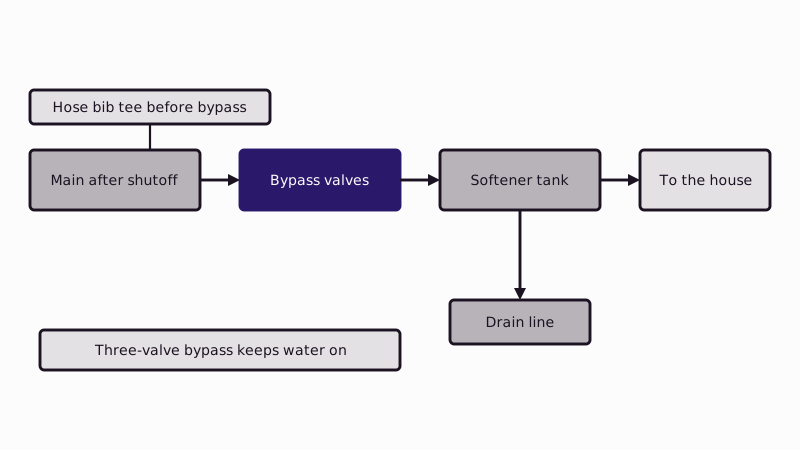
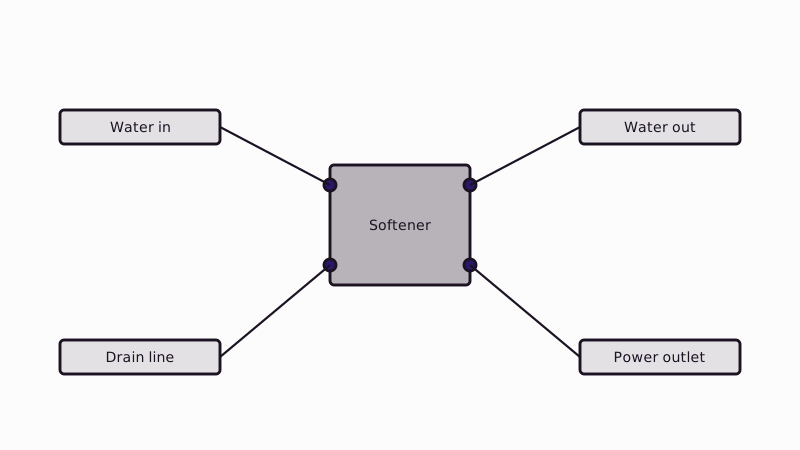
Four connections: water in, water out, a drain, and power. The plumber cuts into the cold main after the shutoff, fits a three-valve bypass, which lets the household keep running while the unit is serviced, then adds a drain line to carry off the regeneration water. The control head needs a grounded outlet nearby.
Placement drives the labor. The unit needs a level slab near the point where water enters, a drain within reach, and an outlet. Westside houses vary here. A 1950s ranch with a garage entry makes it easy; a Spanish Revival bungalow with the main in a landscaped side yard, or a condo with no outdoor access, makes it harder.
A good install also adds a hose bib upstream of the unit so garden and irrigation water skips the softener. Softened water is a poor match for plants and wastes salt on lawn use. Ask the plumber to tee off before the bypass.
For the step-by-step sequence, see how a softener goes in.
Which brands does a plumber hook up?
Any mainstream residential softener installs the same way. Culligan, Kinetico, Whirlpool, Rheem, Aquasana, Fleck, Clack and big-box store models share the same connections: inlet, outlet, drain and brine line. What differs is the control head, the salt tank and the warranty terms the manufacturer sets.
Dealers that sell a softener often bundle their own install, and that is fine, but ask what it covers. Some include a bypass and drain, others leave the plumbing to you. A unit ordered online or picked up at a warehouse club can still be installed by a plumber; leave the manual out for the visit.
Nonelectric and salt-free conditioners are a different animal. They condition rather than remove hardness, they need no drain, and they appeal in places that restrict salt discharge. They will not give the soft feel of a true ion-exchange system, so know which result you want.
Is a salt softener allowed where you live?
Possibly with limits. Regeneration flushes brine into the sewer line, and California lets local agencies restrict or ban self-regenerating units because of salt in wastewater. Rules vary by city and sanitation district. Check with your city, or ask us to, before you purchase a salt-based model.
We do not guess at an ordinance, so the quote notes what your city's counter says. Should a permit be required, the plumber applies. Where a ban exists, you are left with salt-free conditioning or a tank-exchange service.
Rental owners and condo boards add their own layer. Landlords and condo boards must usually sign off on changes to the main line, and in an apartment block the shutoff might not belong to you.
How much does installing a softener cost?
Figures are best taken from the written quote, because they swing with the unit, the plumbing needed and whether the drain and outlet already exist. The softener itself is often the larger cost, and installation labor is a second line on the same bill. See the installation cost guide for the breakdown.
Ask the plumber to list the pieces separately: the unit, the bypass and valves, the drain run, any electrical, and permit costs. A line-by-line quote lets you compare a dealer's bundled price with a plumber's labor alone.
State law sets the license threshold for contractors at $1,000 of work, labor and parts together. A deposit can run no higher than $1,000 or one tenth of the price, taking the smaller figure. The same rules bind a dealer's installer, so the licensing board's search page works for any name.
Can you install a softener yourself?
Technically yes, for an owner at ease with soldering copper or push-fit fittings and a correct drain connection. Many owners do. The risks are leaks inside a wall and a drain air gap done wrong. A mistake here floods a garage, so hire out the part you cannot do cleanly.
A permit and a license are separate questions. California's license rule applies to people working for others, not to owners doing their own work, though local permit rules still apply, so ask the building department. Homes on older galvanized or mixed pipe deserve a plumber's eye, since softener flow can stress corroded fittings.
The cost of a failed DIY is large: water damage often exceeds the labor you saved. If your main shutoff is stiff, corroded or missing, replace it before the softener goes in.
What will a plumber ask you for?
Pull together the hardness report or a test result, the softener manual, your preferred spot for the unit, and where the main shutoff, drain and outlet sit. Photos help. Tell us if you have a well, a pressure regulator or an irrigation tap, since each changes the layout.
The office takes calls on weekdays, nine to five. A visit unfolds as described under the job outline. If scale is hitting your bills in other ways, why a water bill climbs shows where else to look.
Common questions
Where does the brine drain?
Into a washer standpipe, a laundry sink, a floor drain or a purpose-built line, separated by an air gap so wastewater cannot siphon back. Codes require that gap. Which of those your house offers decides how much plumbing the install needs, and the plumber will point it out when walking the site.
Will pressure drop after the softener goes in?
A unit sized right should leave pressure alone. A too-small one, or one with fouled resin or a plugged screen, can pinch it. If pressure drops after installation, the plumber checks the bypass valves first, then the unit's flow rating against how much water the house demands at once.
Is softened water fine to drink?
A salt-based softener adds a small amount of sodium to the water, and some people keep one unsoftened kitchen tap kept for drinking, which plumbers often set up at the kitchen sink. Anyone on a sodium-restricted diet should ask a doctor. The plumber can leave a cold line unsoftened if you ask.
How long will the house be without water?
Replacing a unit in an existing loop tends to be quick, an afternoon at most. A first install that adds drain and wiring stretches further, sometimes a full day. The shutoff period is part of what the plumber estimates on the quote.
More in this guide
- Water softeners and treatment
Santa Monica's delivered water averaged 161 ppm hardness in the city's 2022 report.
- Water softeners and treatment
Installing a salt-based water softener yourself in Santa Monica: location, bypass, drain, hardness settings, scale removal, and where a…
- Softener installation cost
Water softener installation usually runs about $1,100 to $3,000 nationally.
Sources used
Page updated