Dry the joint, then watch it. A leak that appears only when water drains through it is a drain-side joint, and a leak that drips constantly, even at night, is under supply pressure. Drain joints are usually the easier repair. A joint under pressure demands the supply closed beforehand and a proper cure afterward. For the wider picture of where water goes wrong, see leaks and burst pipes.
PVC shows up in several places in a Santa Monica home: drain-waste-vent piping, a laundry standpipe, irrigation lines in the yard, and in some houses cold water supply. Knowing which one leaks tells you the right repair.
Which kind of PVC joint is leaking?
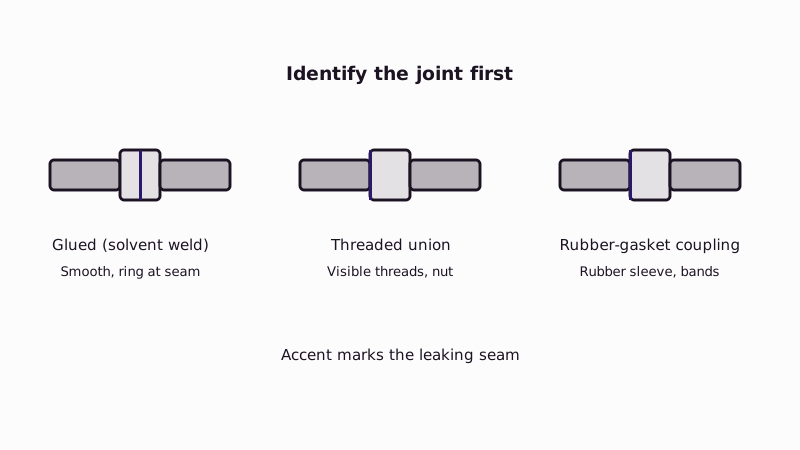
Examine how the joint was built. Smooth and glued, with a ring at the seam, means solvent weld. Visible threads or a nut mean a threaded union. A rubber sleeve with steel bands is a repair coupling. Failure modes differ by type, so each has its own cure.
| Joint type | Why it leaks | Usual fix |
|---|---|---|
| Glued (solvent weld) | Pipe was not fully seated or primed, or it cracked | Remove the joint and install a new section with couplings |
| Threaded or union | Worn tape or O-ring, cross-threading | Remake the joint with new thread seal or a new O-ring |
| Rubber-gasket coupling | Loose band, cracked coupling | Tighten or replace the coupling |
| Slip joint under a sink | Worn washer, loose nut | New washer, hand-tighten, check alignment |
Hot water is not a PVC job. PVC is generally limited to cold water; hot lines in a house use CPVC, copper or PEX, so a leak on a hot line needs another repair path.
Can a glued PVC joint be fixed without cutting it out?
Rarely, and not for long. Putty or a wrap may slow a pinhole on a drain for a while, yet a weeping glued joint on a pressure line needs cutting out and replacing. Glue does not bond a joint that has already failed, so adding more cement over a leak does not hold.
For a drain line, the reliable repair is a rubber coupling with stainless bands. Shut off water to the fixtures above, cut out the cracked section with a PVC saw, and slide the coupling over both ends. Tighten the bands to the maker's instructions. Check for a leak with a full sink of water, then run the laundry or dishwasher if one drains into this line.
For a pressure line, the plan is cut and replace. Turn off the main, drain the line, cut out the damaged joint, dry-fit the new pieces, then apply primer and solvent cement to the pipe and fitting, push the parts together with a quarter turn, and hold them as long as the can directs. Then wait for the cure period on the label before turning on water. Cure times depend on temperature, pipe size and the product, so use the can, not a guess.
Work in a ventilated space, because primer and cement give off fumes, and keep them away from flame.
How do you fix a threaded or gasketed PVC joint?
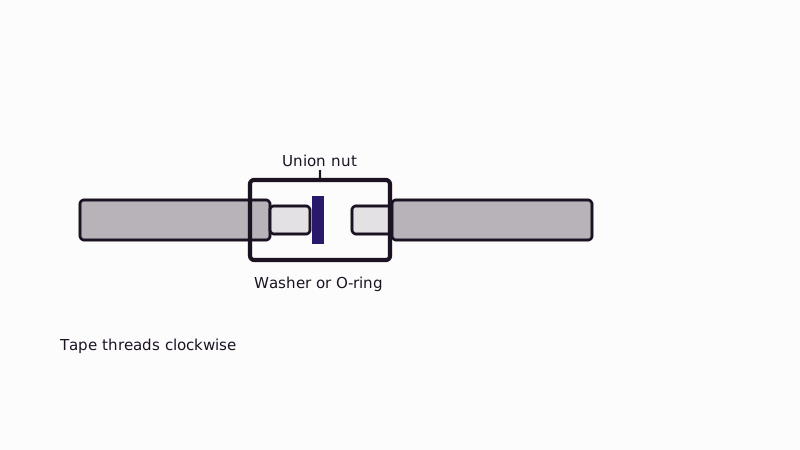
Take it apart, clean both threads, and rebuild it with fresh thread seal tape or paste rated for plastic pipe, or a new O-ring or washer. Hand-tighten, then add a small turn. Overtightening cracks PVC fittings, which turns a drip into a break.
Steps:
- Turn off the water, then bleed the line empty.
- Unscrew the union or nut and inspect the washer for flattening or cracks.
- Replace the washer or O-ring, and clean the threads with a rag.
- Wrap fresh tape clockwise, looking at the threaded end, three or four turns.
- Hand-tighten, restore water slowly, and watch for seepage.
A threaded fitting that is cracked at the threads cannot be saved by tape. Replace the fitting. On a slip joint under a sink, check that the pipes line up straight; a joint pulled sideways leaks no matter how much you tighten it.
What about PVC leaks outside, like irrigation lines?
Yard lines on the Westside are usually shallow and cold water only. Dig around the wet spot, cut out the cracked joint, and use slip repair couplings or a standard glued repair. Tree roots, a lawn mower or foot traffic often crack the fitting, and ground movement in hillside lots can stress joints.
Mark the leak and dig by hand, since a shovel can cut a nearby line. A repair coupling lets you replace a section without moving the pipe ends, which is useful in a tight trench. Test after the glue cures and before you fill the trench. If water bubbles up and you do not know which line it is, a plumber with a leak locator saves digging; see the leak detection cost guide.
When is a leak more than a joint problem?
Get a plumber involved if water escapes from the main supply, from inside the framing, under concrete or above ceiling drywall, if drywall shows stains, or if a repaired joint starts dripping again. A repeat leak points to a pipe that is out of line or under strain, and tape or glue cannot cure that.
Watch for damage that you cannot see. EPA data show the average home leaks away more than 9,300 gallons annually, and a slow drip behind a cabinet can rot its base unnoticed. Water already at a ceiling is covered in ceiling water leaks. More on plastic pipe is under stopping leaks in plastic pipe and pipe leak sealants.
California requires a contractor license for work of $1,000 or more in labor and materials, or any job needing a permit. Santa Monica's municipal code generally exempts stoppage clearing and leak repair from permits so long as valves, pipes or fixtures are not replaced or rearranged, which means swapping out a whole run may need one. Ask the plumber who files, or confirm with the building office.
What will fixing a leaking joint cost?
A basic joint repair is a short visit, so the bill is mostly the trip charge and labor. We found no dependable published range for this job; request a written quote with visit fee, labor and parts on separate lines. Access moves the price: a joint in an open crawl space costs less than one sealed inside a wall.
How trip fees and hourly rates work around Los Angeles is explained in the plumber cost guide. Brittle old PVC supply pipe can justify partial replacement instead of repeated patches; compare materials in PEX versus copper. The quote page gets a visit priced.
Common questions
How long until water is back on?
Swapping a drain coupling or a washer commonly finishes inside an hour. A glued joint on a supply line has to cure before water returns, typically a few hours depending on product and temperature. Ask the plumber for the time water will be back.
Do tape or epoxy work on a weeping joint?
Tape seals only threaded joints. On a glued one it achieves nothing. Epoxy can slow a small leak briefly but is no lasting answer on a pressure line. Cutting the joint out and fitting a new coupling is the dependable cure.
Is a leaking PVC drain joint dangerous?
Typically it is a moisture and mold issue rather than a hazard to life. Drain water can carry contamination, so wear gloves, dry the area quickly with a fan, and disinfect afterward. Gas odor is a different emergency altogether. Leave the building, then ring SoCalGas on 1-800-427-2200.
Do I wait at home during the repair?
Yes, or leave a reliable adult. The plumber needs the shutoff, a clear route to the pipe and room to work, and someone should watch the final leak test. Renters ought to inform the landlord, whose approval may be required.
For the wider picture, start with plumber santa monica.
Sources used
Page updated