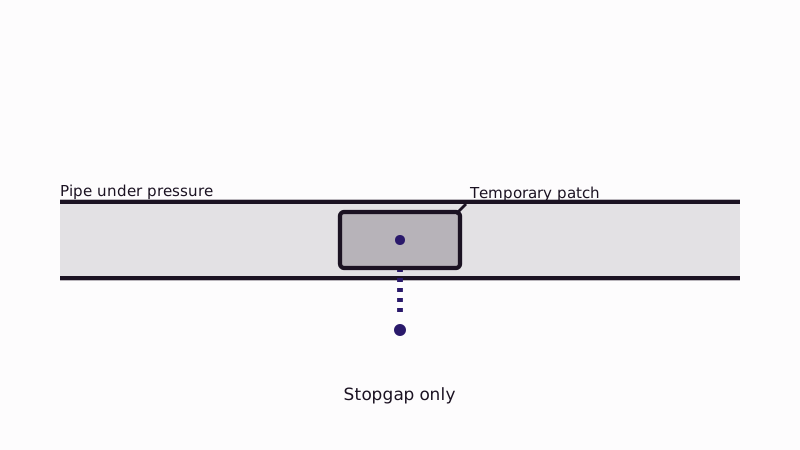
A pipe is weeping, the plumber cannot come until tomorrow, and the hardware store sells a dozen products that promise to stop it. A few will hold back a minor leak for some time. None substitutes for a real repair on a line holding household pressure, and a patch can mask how far a failing pipe has deteriorated. Here is what a sealant can realistically do, which leaks it must never be used on, and how to spend the hours before help arrives. For leak work in general, see plumber services for leaks.
Will a sealant fix a leaking water pipe?
For a tiny leak, such as a pinhole or a weeping joint, a sealant can slow the flow or stop it temporarily, yet the pipe itself is not restored. Our research found no independent test data on any brand, so none is ranked. Use a sealant to gain time and plan the real repair.
Why only a stopgap? A supply pipe is always pressurized and flexes with temperature, and a patch bonded to its outside has to withstand that day after day. Corrosion can also keep spreading beneath it, so the pipe nearby may fail even while the patch holds.
A working rule: the smaller, drier and easier to reach the leak, the better a temporary patch behaves. A seam leaking inside a wall, a split pipe or a fitting pulled apart is beyond any putty.
Which kinds of sealant do people use, and what are they for?
Hardware stores stock epoxy putty in two parts, self-fusing tape, clamp-on sleeves and rubber wraps with clamps. Each is meant for a different leak: putty and tape for pinholes on a clean dry surface, clamps for a hole or a split in a straight run. A leaking fitting under heavy pressure suits none of them.
Here is a practical guide to match tool and problem, without pretending any product is proven:
| Situation | Reasonable stopgap | Better answer |
|---|---|---|
| Pinhole in a straight copper run | Epoxy putty or a wrap | Replace the section |
| Weeping compression or threaded joint | Tighten gently, then a plumber | Redo the joint |
| Split or crack along a plastic pipe | Clamp or repair sleeve | Remove and renew that section |
| Leak hidden in framing or beneath concrete | None; shut the water off | Leak detection and a plumber |
| Corroded galvanized steel | Not worth patching | Replacement; see galvanized pipe replacement |
Look for products that state they are suitable for drinking-water lines when the pipe carries potable water, and read the label for pressure and temperature limits. Hot lines are harder than cold ones.
Specific materials have their own pages: pinhole leaks in copper, leaks in plastic pipe and PVC joint repair.
What do you do before applying anything?
Stop the water first. Santa Monica requires a property shutoff on every building, often on an outside wall near a hose bib. Failing that, the city's valve sits in the meter box and is for city staff only; Water Resources answers at 310-458-8531. After closing it, let the lowest tap downstairs run dry.
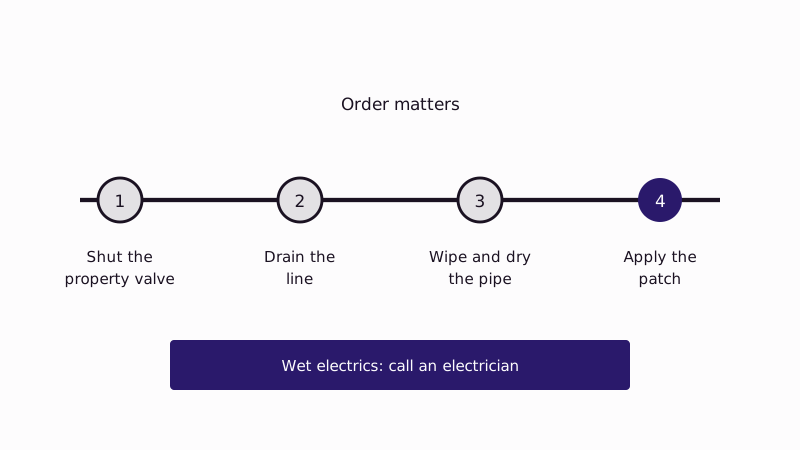
Sealants bond only to a dry, clean surface, another reason to drain the line first. Wipe and dry the pipe, abrade it if the directions say so, and respect the cure time on the packaging. A pipe you cannot get dry will defeat the patch.
Stay away from wet electrics. If water reaches outlets, fixtures or the panel, keep clear and call an electrician, or leave the house. Gas piping near the leak, or any gas odor, sends everyone outside, and SoCalGas is phoned from the yard at 1-800-427-2200.
Fixture leaks have a simpler stopgap: the small stop valve beneath a sink or beside a toilet isolates that one fixture and leaves water on elsewhere.
When is a sealant the wrong idea?
Skip it when the leak is within a wall, ceiling or slab, when a pipe has split open, and when old pipe is corroded in several places. It is also wrong for gas piping, sewage drains and any pipe you cannot see. A patch hides the signs and can delay the right repair.
Leaks in several places usually mean the pipe is aging. A string of patches adds up and still leaves a failing system, so the better question becomes whether repiping makes more sense. A pipe that has burst is covered in the burst pipe guide.
Under a floor or behind a ceiling, leak detection finds the source so nobody has to guess; the leak detection price guide describes the visit. Whatever you apply, shoot photos of the damage for your insurer.
Why does a small leak deserve attention at all?
Because small leaks add up. The EPA's household average is a loss of 9,300-plus gallons yearly. Moisture in walls and under floors can also feed mold, and the EPA says absorbent materials such as carpet can be a write-off once moldy.
The agency urges prompt repairs and thorough drying, and treats about 10 square feet of mold as the point where professional help makes sense. Cabinets and floors near a slow leak can swell and stain before water is ever visible.
Telltale signs: a water bill rising unexplained, a musty smell, staining along the base of a wall, bubbling paint, or water sounds with every tap closed. The overhead version of the problem is explained under ceiling water leaks.
What does a proper repair cost compared with a patch?
We have no sourced price for sealants. For a proper repair, Fixr's burst pipe guide shows $200 to $1,000, $500 on average, with plumbers listed at $45 up to $200 hourly (the page dates from August 2022). Bob Vila lists service call fees at $100 to $350. The written quote sets your own price.
Context helps: Fixr lists water damage repair at $1,200 to $5,000, so a proper repair can cost less than the mess a failed patch leaves. Ask whether the quote includes locating the leak, mending the pipe and closing up the wall.
Bigger repairs call for a contractor holding the matching state classification. A small patch you apply is your own risk, but repairs involving gas, permits or hidden pipe belong with a plumber.
Common questions
Will a sealant hold a pipe that has burst?
No. A burst pipe has already failed under pressure, and putty or tape will not hold it. Close the property valve, drain the line and phone a plumber. A clamp or wrap may slow a minor split in the meantime, but only repairing that section restores the pipe.
How many months can a patch be trusted?
Nobody can say from the sources we read, so no number is given. Durability depends on the product, the surface, pressure, temperature and how well the pipe was dried and cleaned. Treat any sealant as temporary, inspect it often and book the permanent repair.
Is it okay on pipes carrying drinking water?
Only products labeled for drinking-water lines belong on potable supply pipes. Read the label and avoid anything intended for roofs, tanks or drains. If it does not say drinking water, ask a plumber or choose a clamp or sleeve designed for supply lines.
What about a pipe hidden in the wall?
Leave it alone. A hidden pipe cannot be dried, cleaned or inspected, so a patch achieves nothing. Close the water, record the damage and contact a plumber. Leak detection pinpoints the source so the opening in the wall stays as small as possible.
Where does DIY stop?
When the leak is hidden, the pipe has split, new leaks keep appearing, the water is hot, gas is close or you are unsure. Anything needing a permit goes the same way, and the contractor's license number belongs on the contract.
Want the leak found and fixed properly? A local visit starts at the quote page, and our other services are shown on the Sunset Coast Plumbing home page.
Sources used
Page updated