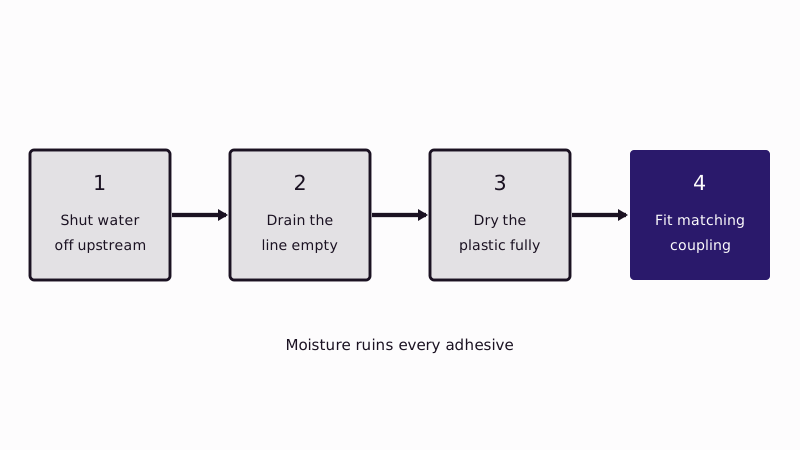
Start by closing the valve on the supply side of the damage, then let the pipe empty, dry the surface, and fit a repair coupling or a rubber sleeve with clamps. With PVC, CPVC or PEX, that holds long enough to arrange a permanent repair. When you reach that stage, the home page lists the work a local plumber is sent for. The sections below cover plastic types, yard lines, faucets, clamps, who owns what, and insurance. Gas piping is a separate matter that California leaves to contractors.
What actually stops a leak in plastic pipe?
A dry surface and the matching coupling do the job. Close the water upstream, let the pipe run empty, then towel the plastic until nothing is wet. Then choose by the kind of damage: a rubber sleeve with clamps as a fast hold, a slip coupling over a clean crack, a push-fit or crimp connector on PEX, new solvent cement where a PVC or CPVC joint let go.
Moisture ruins every adhesive, tape and putty, which is why emptying the line comes before anything else and why a towel and bucket belong in the kit. Once the repair is on, open the supply slowly and stay nearby for ten minutes.
Which plastic is this, and does it change the repair?
It does, since each material joins differently. Rigid white or gray pipe is normally PVC. Rigid cream pipe is CPVC, used on hot and cold supply. PEX is the bendy tubing, usually colored red, blue or white. The wrong glue or fitting gives out within days, so name the material before shopping.

| Pipe | Appearance | Dependable repair |
|---|---|---|
| PVC | Hard, white or gray, commonly drains or irrigation | Remove the damaged stretch and splice in couplings with PVC primer and cement |
| CPVC | Hard, cream or pale yellow, hot and cold supply | Same approach, but only CPVC cement works, never the PVC type |
| PEX | Flexible and color-coded | Cut it and join with a crimp ring, clamp ring or push-fit coupling made for PEX |
| ABS | Hard, black, drains alone | ABS cement, with a transition coupling at any join to another plastic |
Pipe with a worn-off label can be identified at a hardware store counter if you carry in a cut sample.
How do I stop a plastic pipe leaking outside the house?
Close the zone valve for the irrigation or hose bib, uncover the break, and swap the cracked piece using a coupling made for that pipe. Roots and sunshine age plastic outdoors, so near-surface sections turn brittle. Anything buried deeper on the run from meter to home belongs to a plumber.
Coastal conditions add a twist. Salt air and strong sun leave PVC chalky and brittle, so a hairline split often signals that the entire shallow run is aging, and swapping only six inches may last a season. If the broken pipe is the main that crosses the yard, phone a contractor before opening a trench, and phone 811 before digging anywhere.
What if the leak is coming from a tap?
A drip from the spout or the handle base usually means a tired cartridge, a hardened washer or a cracked O-ring, not a pipe. Shut the angle stop under the sink or fixture, remove the handle, put in a new seal and reassemble. Water at the supply hose or its nut beneath the sink usually just needs a new braided hose.
Faucet cartridges differ by brand, so buy the spare that matches yours. A step-by-step guide to fixing a leaky faucet is available, and the page on pipes leaking under the sink deals with the plumbing under the basin.
Is a homemade pipe clamp safe, and how do clamps come off?
A homemade version is a strip of bicycle inner tube or old garden hose laid across the split and cinched by stainless hose clamps on each side. Count on a day or two at most. A rubber-lined clamp from the plumbing aisle is far steadier and the sensible pick.
Loosen a band or hose clamp by backing the screw or bolt out until the strap opens and slides away. When tightening, make small turns and alternate sides on a two-bolt model. Too much force bites into thin plastic and widens the crack, so stop as soon as the dripping stops. A clamp should never serve as the final repair inside a wall.
Who is responsible for the water pipe coming into the house?
The utility normally looks after the line as far as the meter. Everything past it, including pipe inside the walls, falls to the owner. Policies differ by utility, so confirm with yours. Santa Monica runs its own city water department, while Los Angeles neighborhoods such as Brentwood and Venice are listed in LADWP's water quality report. Your water bill names your provider.
A break at or ahead of the meter goes to the utility, which may handle it. Past the meter, the owner pays. Contact details sit on the Water Service page of the city website. A renter's first move is a note to the landlord, because the lease and California habitability rules put most pipe repair on the owner.
Will homeowners insurance cover a broken water pipe?
Frequently, when the damage is sudden and accidental, such as a pipe that bursts and soaks a room. Slow leaks, corrosion and gradual wear are usually excluded, and the bill for the failed pipe frequently goes unpaid. Wording varies between insurers, so read your policy and ask the carrier before assuming.
Take photos, stop the water, and keep the repair receipt. Tell the insurer before any big cleanup. The article insurance and burst pipes digs deeper.
How long do house water pipes last?
That depends on the material and on the water. Plastic can run for decades, while old galvanized steel corrodes inside and fails sooner. Many Westside houses built before 1960 still run galvanized or first-generation copper, and those lines are first in line for replacement. Brown water, a fresh leak or sagging pressure tells you more than the calendar.
When one stretch of plastic or copper keeps failing, replacing it generally beats patching again and again. Redoing the entire house is a larger call, covered on the repipe page and in the guide on how often to repipe a house.
How can I spot a dodgy plumber?
Walk away from anyone who refuses a written estimate, asks for a large cash sum up front, or cannot supply a contractor license number that can be verified online. The state wants a license once a project hits the thousand-dollar mark, and it limits what may be requested as a deposit.
Further warning signs include a price named without seeing the pipe, pressure to sign on the spot, and an explanation made only of jargon. A good contractor describes plainly what failed and why the fix should last.
Common questions
How do I keep pipes from bursting?
A regulator set no higher than 80 psi, wrapped outdoor pipe on a rare freezing night, corroded sections replaced early, and a main shutoff you could find in the dark all help. Check under sinks and near the heater for slow drips every season. The burst pipe prevention guide has more.
What shows a plumber is padding the bill?
Collect two written estimates that break out labor, parts and any call-out fee, and settle the hourly rate and a ceiling before work starts. Published price guides serve only as a rough yardstick. A big gap above them calls for questions, nothing more.
Is a small leak worth worrying about?
Yes. A typical home's leaks add up past 9,300 gallons each year, says the EPA, and even a modest drip softens cabinet floors and encourages mold. Repair it soon, and immediately when water is near wiring or an outlet, before the damage spreads any further.
Write up the leak and where it is on the quote page.
Sources used
Page updated