Test two things before touching a tool: does the weak flow affect hot, cold or both, and do other fixtures in the house run normally? When every other tap is strong, the trouble sits at the kitchen sink: most likely a gummed-up aerator, an angle stop turned only partway, a bent hose, or grit in the cartridge. Trouble at every tap belongs to a different diagnosis, handled later on. Other sink-side jobs live under garbage disposal and kitchen repairs.
Is the problem the faucet, or the whole house?
Try a bathroom basin, the shower and a garden spigot. Strong streams there blame the kitchen faucet and its two feeds. Weak streams all round point upstream: main valve, regulator, or the street. Hot-only weakness at several taps points at the water heater or galvanized hot lines.
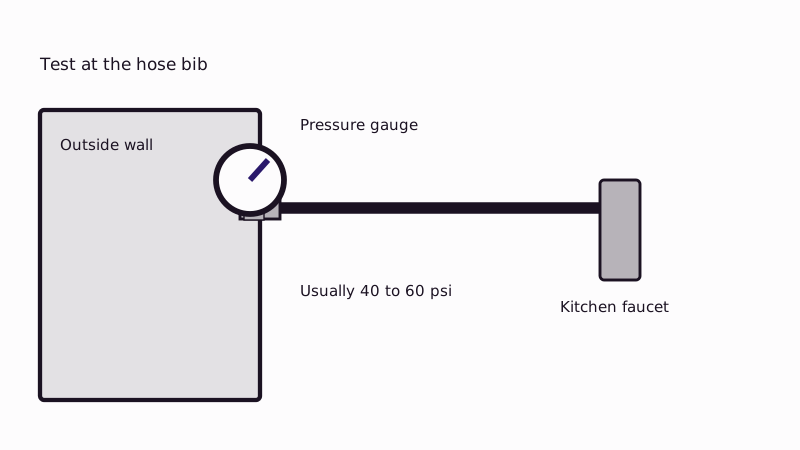
A cheap screw-on pressure gauge at a hose bib tells you the truth. Households usually see 40 to 60 psi. Anything above 80 psi is where the state plumbing code requires a regulator. Readings far below that suggest a regulator, a partly closed main valve or a supply issue worth raising with the water utility.
Could the aerator be clogged?
Very often. The aerator is the small screened cap at the spout tip, and mineral scale and grit fill its mesh until the stream thins out. Twist it off by hand, or grip it with pliers over a cloth, tap out the grit, soak the pieces in vinegar for an afternoon, and rinse. Reinstall it, and the flow usually jumps back to normal.
Hard water turns this into a repeat chore, as scale returns within months. Water hardness differs between the City of Santa Monica, LADWP and other suppliers, so check your supplier's quality report if scale is heavy. On pull-down faucets, also unscrew the spray head and check its screen; the spray hose itself can kink inside the cabinet.
Are the under-sink shutoffs and hoses limiting flow?
Look under the sink. Each supply has an angle stop, a small valve with a handle or screwdriver slot. If it is only partly open, flow drops. Open fully, counterclockwise. Flexible braided hoses can kink when stuffed behind a disposal or a water filter, and filter cartridges clog with sediment, so bypass or replace a filter and test again.
Do not force a stop valve that seems frozen, since a brittle old one can start leaking when turned. If the valve will not move, leave it to a plumber. Replacing both supply lines and stops during a faucet swap is inexpensive insurance, particularly in older Westside houses with original brass or galvanized stubs.
What if the cartridge inside the faucet is worn?
Single-handle faucets use a cartridge that can fill with sand, scale or pipe debris, typically following nearby plumbing work or a main repair. Close the stops, then pull the handle and cartridge following the maker's instructions, and rinse or replace it. A cartridge that is pitted or cracked should be replaced with the exact model.
When the faucet is old, a replacement can be cheaper than parts. See how much installing a faucet costs for the price drivers. Low flow with a new faucet can also be a built-in flow restrictor: many faucets limit flow to about 1.5 gallons per minute or less to save water, so do not mistake design for a fault.
Why is only the hot or only the cold weak at the kitchen?
One-sided weakness traces to that side's supply. Hot only: suspect a sediment-choked heater, a heater valve open just a crack, or scaled pipe. Cold only: start with the cold angle stop, a filter or a plugged inlet screen. A water heater that is full of sediment can restrict flow at every hot tap, not just the kitchen.
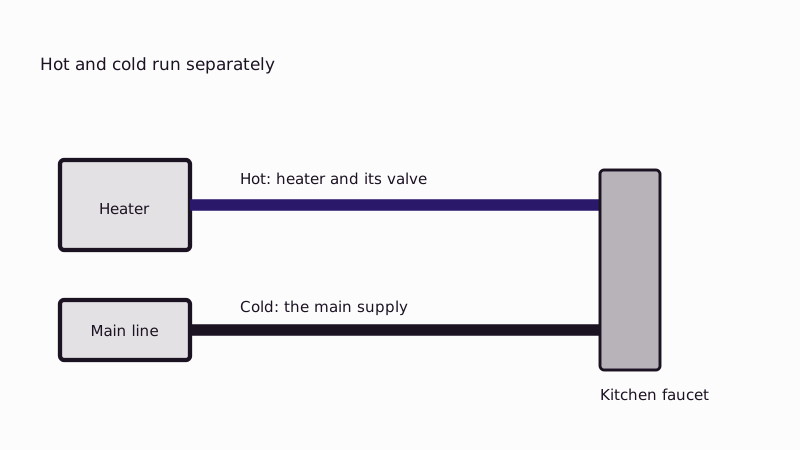
Flushing the heater tank often restores hot pressure, and the guides on low hot water pressure and no hot water from a faucet go through the specifics. Old galvanized pipes narrow from rust over decades, and that kind of restriction needs a plumber and may point to a repipe.
When is low kitchen pressure a sign of something bigger?
If all fixtures run weak, if pressure dropped suddenly, if the water meter spins with everything off, or if water bills rose, look for a leak, a failing regulator or a utility problem. A hidden leak that steals pressure wastes water as well; EPA WaterSense counts 9,300-plus gallons a year lost in an ordinary household.
A failed pressure regulator can also swing both ways: weak flow, or dangerous spikes that hammer pipes and damage fixtures. The guides on sudden low pressure and where a regulator sits explain how to confirm it. Regulator replacement is a plumber's job in most cases.
Common questions
How quickly can the flow be restored?
An aerator cleaning is a ten to fifteen minute job. Stop valves and hoses add a few more, and swapping a cartridge rarely passes an hour. A plumber visit to diagnose and fix a local cause is commonly a one-hour job. Whole-house causes take longer to find, and may need a pressure test.
What should the estimate cover?
Look for whether diagnosis is included, the visit fee, and whether parts sit on their own line. Insist on written figures, and ask what changes if the real cause is house-wide. A job nearing $1,000 triggers California's contractor license rule, so run the number through the state board lookup.
Do I have to stay in?
An adult should empty the sink cabinet, demonstrate where flow is weak and approve extras like new hoses, which spares a second trip. The quote page is the place to list the symptoms and affected faucets, so the visit starts with a plan.
Can a filter or softener choke the flow?
It can. A clogged filter cartridge or an undersized under-sink filter can cut flow sharply. Replace the cartridge, or bypass it temporarily to see if pressure returns. A water softener with a failed valve can also restrict flow. If bypassing restores the pressure, the filter or softener is the culprit.
Will a new faucet fix it?
Only if the faucet is the cause. Test the aerator, stops and hoses first, since a new faucet on a restricted supply will be restricted too. If the old unit is badly scaled, leaking or has a worn cartridge that is no longer sold, replacing it makes sense, and supply lines can be swapped in the same visit.
The rest of our guides start from Sunset Coast Plumbing.
Sources used
Page updated