Shut the water off, pull the handle, lift out the cartridge or stem, and replace it with an identical part. That sequence cures most tub faucet drips, and the hard part is matching the part, not turning the wrench. A dripping spout points to a worn seal inside; water at the handle needs another fix, covered below. Other fixture trouble is gathered in the hub for faucets, sinks and disposals.
What makes a tub faucet start dripping?
Inside every tub valve a rubber or ceramic seal presses shut against a seat when you turn the handle off. Over time they wear, stiffen or collect scale, and a thread of water slips through. You hear it as a patient plink from the spout or showerhead, loudest at night.
Water that is rich in minerals speeds this up. Santa Monica's supply measured around 160 parts per million of hardness in the city's latest report, so scale builds on seats and cartridges. Small as it looks, the EPA estimates a one-drip-per-second faucet loses upward of 3,000 gallons yearly, and a showerhead at ten drips a minute more than 500. Worn seals never heal on their own.
What type of tub faucet do you have?
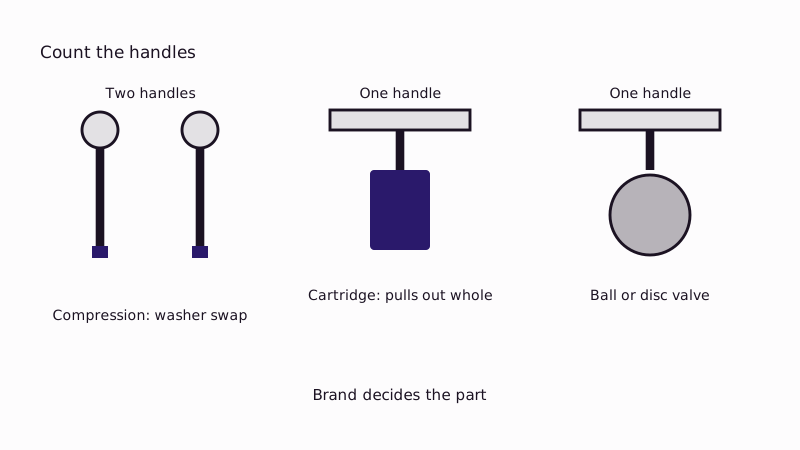
Tub valves come in three common designs: two handles with separate hot and cold stems, one handle driving a cartridge, and one handle on a ball or disc mechanism. Count the handles: two knobs suggest compression stems, a single lever suggests a cartridge.
Compression stems rely on a rubber washer that is quick to change. Cartridge valves, common in many Moen, Delta and Kohler models, use a cartridge you pull out whole. Ball and disc valves have a rebuild kit. Look for a brand name on the handle or inside the escutcheon, and take photos before you disassemble. If the valve is a mixing type that also feeds the shower, a diverter on the spout may be the drip culprit, and its seal is a separate part from the valve.
How do you shut off the water before starting?
If the tub has its own stops, they sit behind a panel on the far side of the wall or in a closet. Most don't, so close the main water valve, open a faucet at a lower level to drain the lines, and confirm the spout runs dry. A rag in the drain keeps screws from disappearing.
Older Westside houses often have no tub stops at all, and some have a main valve that is stiff after decades. Turn it gently, and if it does not close fully or starts to weep, stop and call a plumber, since a main valve that fails mid-job turns a drip into a flood. Gloves help, and so does a bucket under the spout. The handle comes off with the right tool, usually a small screw under a cap or a hex screw on the side.
How does the cartridge, stem or washer swap go?
Take off the handle and trim, release the clip or nut, draw the cartridge straight out with pliers and hold it against the replacement. Push the new one in oriented like the old, replace the clip, reassemble, and bring the water back slowly. On compression stems, unscrew the stem and change its washer and seat.
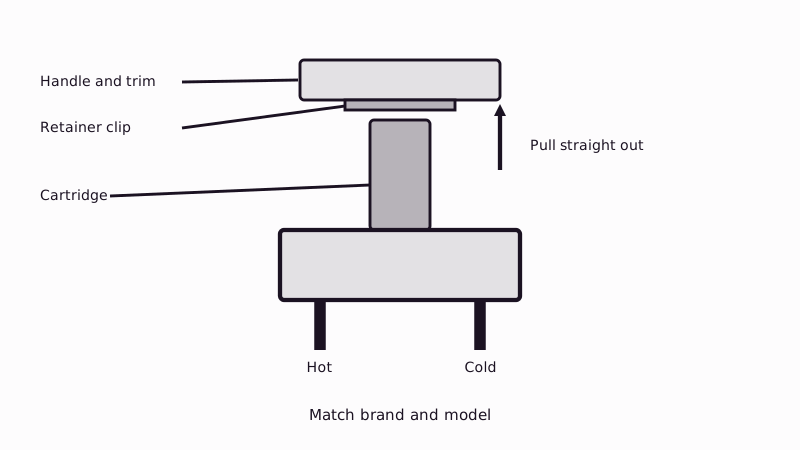
Cartridges can stick, particularly after decades of hardness scale. Wiggle rather than yank, and a puller tool avoids damage. Match the new part by brand and model number, or bring the old one to a plumbing counter. For a single-handle Moen, the retaining clip and the cartridge's position marks matter, and a cartridge turned half a revolution can swap hot and cold. Apply plumber's grease on the seals, hand-tighten and then check for drips for a few minutes. A plumber's visit for a cartridge swap is priced on a written quote, so ask for the part and the labor as separate lines.
Why is water coming out around the handle or the spout?
Seepage at the handle or behind the trim usually traces to a worn seal ring or a loose packing nut, and dampness where the spout joins the wall points to a failed seal or caulk line. Replace the rings, snug the nut or reseal the spout, then watch it.
A drip behind the wall that shows up on the ceiling below needs a different approach, since it means a connection inside the wall is wet. In that case stop using the tub and see shower leaks before opening any tile. A tub spout that leaks from its diverter when the shower is on is a diverter repair, and many spouts simply unscrew or release from a set screw. Swapping the whole spout is often cheaper than hunting for a part.
Does the same repair work on a bathroom sink faucet, Moen included?
Largely yes. Close the stops under the basin, remove the handle, extract the cartridge or stem and replace it. Moen two-handle sink faucets hold a cartridge with a retainer clip, while older brass faucets use a compression washer. A drip that survives the swap suggests a pitted seat.
Cleaning the aerator and the seat can restore a faucet before you replace anything. Now and then a worn, pitted or discontinued faucet costs less to replace than repair, and the figures sit in faucet installation costs. More bathroom steps: the bathroom sink faucet guide and the broader leaky faucet walkthrough.
And if the pipe below the kitchen sink is the one leaking?
Locate the source first by drying everything, laying dry tissue beneath each joint and running the tap. Water at a slip nut means a tired washer or a nut needing a quarter turn; at a supply line, a failing hose; at the trap, a cracked trap or a loose joint.
Tighten by hand, replace the nylon or rubber washer, and swap the braided supply hose if it is stiff or bulging. A cracked plastic trap costs little to replace. Don't overtighten plastic nuts. A corroded metal pipe, or a shutoff that won't close, is a plumber's job. The fuller diagnosis is in leaks under the sink.
Common questions
The drip only happens on hot. What does that mean?
Heat expands the old rubber and it may seat poorly, or hot-side water carries more mineral scale. A worn hot-side washer, seat or cartridge is the likely cause. Replace the hot stem or the cartridge, and clean the seat. If both sides drip, change both while the handle is off.
Can I skip shutting the main?
Only when the tub has working stops, because a cartridge can't be pulled under pressure. Look for stops behind an access panel first. If the main won't seal, don't proceed, and a stop that is stiff, seized or leaking is a job for a plumber.
What does a tub faucet repair cost with a plumber?
The written quote sets the price, and no source linked on this page gives a verified figure for it. A cartridge swap is the smaller job. Replacing the valve inside the wall costs more because the wall may open. Ask for the part, the labor and any wall repair as separate lines.
Is a whole new faucet necessary?
Not usually, since a cartridge swap is the smaller job. Most drips are cured by a cartridge, washer or seat. Go for a new one when the body is cracked or pitted, parts are discontinued or the trim is shot, and compare against a faucet installation quote.
Does a drip below the sink need urgent attention?
Rarely, unless water is spraying. Close the stops, slide a bucket underneath, and see whether snugging a nut slows it. Slow leaks still rot cabinets and breed mold, so don't leave it for weeks. If you can't close the stops, shut the main.
Find other services on the Sunset Coast Plumbing home page.
Sources used
Page updated