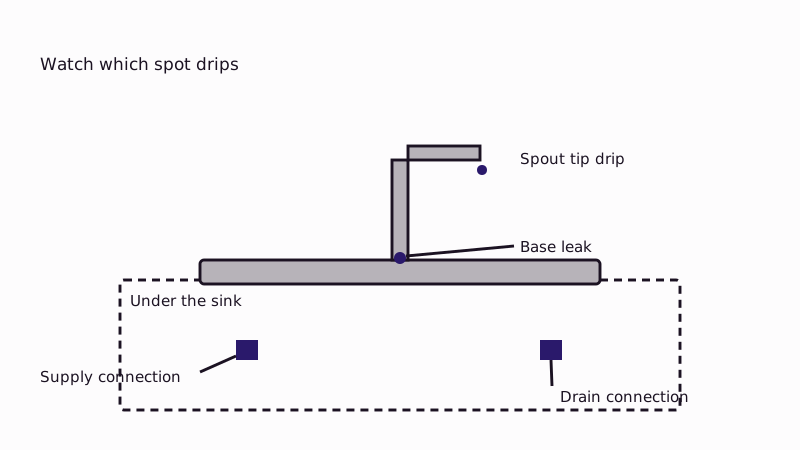
Dry the sink and the faucet with a towel, run the water once, then watch for a minute. The first place a bead of water shows is your answer. Out of the spout: worn internal parts. Around the base or handle: seals or a loose fitting. Under the sink: a supply line, a connection or the drain. This page follows that logic, fixture by fixture, and keeps the repair within what a careful owner can do. Cabinet, disposal and drain trouble beneath the sink has its own home at garbage disposal and sink plumbing.
Which spot is the water showing up at?
Pin down the spot before taking anything apart. Beading at the spout tip while the faucet is closed is a worn valve part. Water gathering around the spout's foot means worn O-rings. Seepage at the handle suggests a tired seal or a loose fitting. Dampness in the cabinet points to a supply line, a connection or the drain.
Use this quick map:
| Where it leaks | Usual cause | First move |
|---|---|---|
| Spout drips while closed | Worn washer, seat or cartridge | Replace the internal part |
| Puddle where spout meets deck | Worn O-rings | Replace the O-rings |
| Handle leaks when on | Worn packing, seal or loose handle nut | Tighten, then replace the seal |
| Spray from the neck or hose | Sprayer hose or its connection | Check the hose and connection |
| Wet cabinet floor | Supply line, shutoff valve, drain or disposal | Dry, then trace with a paper towel |
The EPA lists dripping faucets among the most common household leaks and says they usually come from worn washers or gaskets. That fits the map above: nearly everything on it is a small rubber or ceramic part that wears out with use.
Dry the cabinet beneath the sink and wipe each connection with a paper towel. The one that darkens first is the leak. Then you know whether the job is faucet repair or something else.
What do you do first, whichever part is bad?
Stop the flow to the faucet before touching anything; the EPA's own repair advice is to turn off the supply line first. Beneath the sink, close the two small valves for hot and cold until they stop. After that, let the faucet run dry to release pressure, and plug the drain with a rag so a dropped screw cannot disappear.
Spread a towel in the basin, snap a photo of the faucet, and lay parts out in the order they come off. The photo spares you guesswork on reassembly. Hold on to the old part, since a hardware store can match a new one against it.
If the small shutoff valves will not close or they weep, stop there. Handling those belongs to a plumber, as does any case where the water cannot be cut off at the faucet. The house shutoff, often near a hose bib on an outside wall, stops water for the whole building.
Never force a stuck handle or nut; penetrating oil and patience beat brute strength.
What cures a spout that will not stop dripping?
A spout that drips hides a worn part in its valve. Wikipedia explains that in older washer-type taps the rubber washer and the seat wear until they stop sealing, while modern ceramic cartridge valves are swapped as a single cartridge. Work out which type you own, then renew whichever of the two applies.
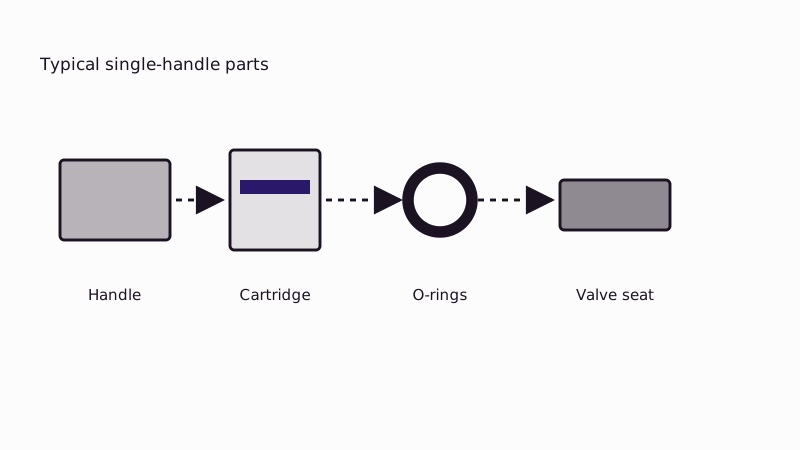
For a typical single-handle faucet with a cartridge:
- Close both supply valves.
- Pry up the small cap on the handle, remove the screw below it and take the handle off.
- Remove the nut or clip holding the cartridge, noting its orientation, and pull the cartridge out.
- Match it at a store, or look up the model number on the faucet's label.
- Insert the new cartridge facing as the old one did, lock it down and reassemble.
- Reopen the supply valves gently and watch for drips.
Two-handle faucets with washers work differently. Each handle sits on a stem; pull it, change the washer on its end and examine the seat. A rough or corroded seat can be smoothed or replaced, and Wikipedia notes that washers can be replaced and seats resurfaced, though not forever.
Parts are modest in price, though we found no sourced figure for a kitchen faucet cartridge, so check the price at the store.
Why does water pool around the base of the spout?
Swiveling spouts seal with O-rings. Once those dry out or wear, water creeps out of the base whenever the faucet runs. The cure is lifting off the spout, usually after releasing a set screw or retaining nut, rolling off the old rings and fitting new ones of identical size.
Smear a little plumber's grease on the new rings so the spout turns freely. Reassemble and run the water to check. If the base is leaking from a cracked body, corrosion or a loose mounting nut below the deck, the faucet may be at the end of its service.
Plenty of Westside kitchens keep a faucet older than the last remodel, and mineral buildup can seize old parts. If something refuses to move, stop before it breaks. In older houses the shutoffs under the sink may be stiff or leaky, and replacing them is plumber work.
Scale from hard water also clogs the aerator and cartridge; the annual report from your water supplier gives the hardness figure. For weak flow, take the aerator off the spout tip and soak it in vinegar.
When is the leak not the faucet at all?
If the moisture is inside the cabinet, trace it. Usual sources are the flexible supply lines, shutoff valves, drain trap, dishwasher connection and garbage disposal. Those leaks are plumbing work, not faucet work, and some, such as a corroded line, deserve prompt attention.
A loose slip nut can be snugged by hand or with pliers, never overtightening plastic. A cracked flexible line gets replaced, not wrapped. If a drip's origin is unclear, dry everything and wait with a paper towel. A leak that appears only while the disposal runs points to a disposal seal.
Related fixes live on other pages: leaky faucets in general, pipes leaking under the sink and a clogged kitchen sink. A weak stream is the subject of low pressure at the kitchen faucet.
When does buying a new faucet make more sense?
Go for a new faucet when the body is cracked or corroded, parts are discontinued, the finish has worn through or repairs keep failing. A faucet that drips again soon after a fresh cartridge usually has a damaged seat or body. The new unit costs more than a cartridge, but repeated failed repairs cost more still.
Replacement is bigger: shutoffs, supply lines, mounting hardware and sometimes sink holes come into play. A plumber can swap a faucet in a single visit, and faucet installation pricing shows published ranges.
Bob Vila shows plumber rates from $45 to $200 per hour and a call-out of $100 to $350 that often includes hour one. Those are national guides, and the quote written for your address is the price. For perspective, a faucet drip is one slice of the household leak total the EPA averages at over nine thousand gallons yearly.
A faucet repair sits far below the dollar threshold for California's contractor license rule, but gas, permits or a hidden leak should go to a contractor.
Common questions
What makes the faucet keep dripping once it is off?
A part inside the valve has worn: usually the washer or seat in older two-handle faucets, the cartridge in single-handle ones. The EPA says dripping faucets usually trace to worn washers or gaskets. Shut off the supply, replace the part and test. If the drip returns, suspect a damaged seat or body.
Must the water be off before I start?
Yes. Close the pair of stop valves under the sink, then let the faucet drain itself dry to release pressure. The EPA says to shut the supply before any faucet repair. If those valves refuse to close or leak when turned, stop and phone a plumber, because forcing them can create a bigger leak.
What tools should I gather?
Screwdrivers, an adjustable wrench, pliers, Allen keys for set screws, plumber's grease, a towel and a cup for small parts. A flashlight helps inside the cabinet, and penetrating oil frees stubborn pieces. Bring the old part along when you shop so the replacement matches.
How long does the job run?
For a cartridge swap, allow about an hour if nothing is stuck and longer if parts are corroded; that is our rough guide, not a sourced figure. Leave time to dry the cabinet, test for leaks and clean up. A plumber's simple faucet repair is usually a short visit.
Is it worth fixing a slow drip?
Yes. A drip pads the water bill and keeps wearing the valve, and a modest part usually costs less than the water lost. The EPA counts dripping faucets among the common household leaks. Fix it before it becomes a stained cabinet or a damaged countertop.
Prefer to hand it over? Book a look through the quote page. Our other jobs appear on the Sunset Coast Plumbing home page.
Sources used
Page updated