Close the stop valve, take the handle apart, and replace the one component letting water by, usually a washer, a ring seal or a cartridge, depending on the faucet. A modest parts bill and an unhurried afternoon settle most drips. Related fixtures are grouped in faucets, sinks, showers and disposals, the hub for this page. The designs below are the ones a Santa Monica house is likely to contain, from the kitchen sink to the hose bib on the side wall.
How do I identify the faucet before dismantling it?
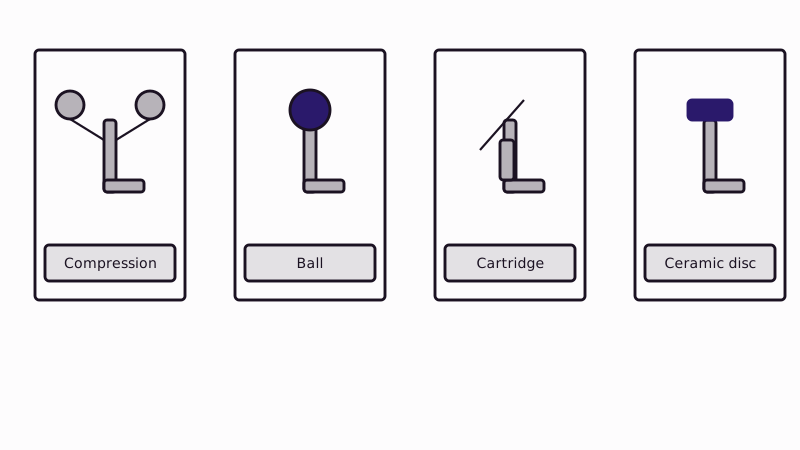
Look at the handles and how they move. Two handles that keep tightening as you turn them are generally compression faucets. A single lever that sweeps side to side is a ball, cartridge or ceramic disc type. The design points to the worn part, so settle that first and photograph each step as you take things apart.
| Signs | Design | Worn part |
|---|---|---|
| Two handles, a rubber seat felt when shutting off | Compression | Rubber washer and seat |
| One lever, rounded cap above the spout | Ball | Seals and springs |
| One lever or knob, metal stem inside | Cartridge | Cartridge, or the rings around it |
| One lever, smooth quarter-turn feel | Ceramic disc | Disc seals |
Older Craftsman and Spanish Revival houses on the Westside often keep compression bath faucets, and those are the easiest to rebuild.
What is the basic method for stopping a drip?
Shut both stop valves, open the tap until it stops, then plug the drain opening with a rag against dropped screws. Pry the cap off, unscrew and lift the handle, then extract the damaged piece. Take it to a hardware counter for an exact match, then reassemble in the opposite order.
The sequence that keeps things trouble-free:
- Close the supply, then open the faucet to prove nothing flows.
- Pop the decorative cap with a thin blade and unscrew the handle.
- Loosen the packing nut or bonnet and withdraw the stem or cartridge.
- Inspect the seat. A pitted brass seat shreds new washers, and a seat wrench or resurfacing tool fixes it.
- Smear plumber's grease on rubber parts, put everything back, and reopen the supply gradually.
What causes a kitchen faucet to leak?
Most kitchen faucets are single-lever cartridge or disc models. Moisture collecting at the spout's foot signals tired swivel O-rings. A drip from the tip comes from the cartridge or disc seal. Buy the cartridge made for that exact model, because a near match often fails again.
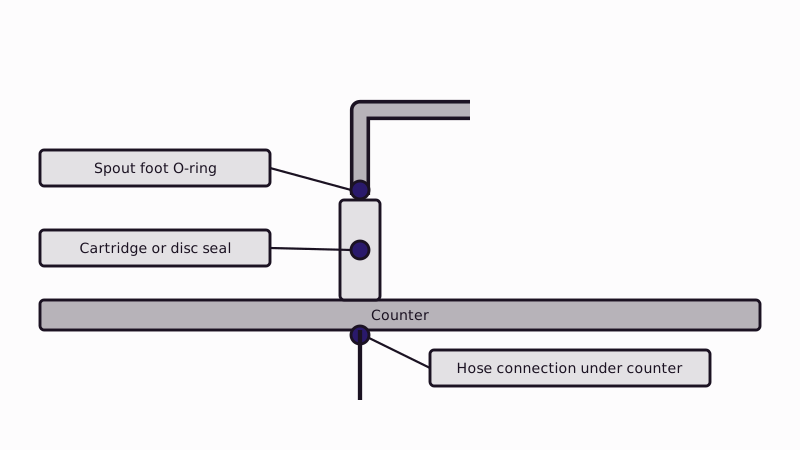
The brand and model are on the box under the sink or stamped inside the handle. Pull-down sprayers add a second weak point at the hose connection below the counter. Snug it with your fingers and add one-eighth turn using a wrench. Check nearby garbage disposal fittings while you are under there, since kitchen leaks like to hide in that spot.
What is different about a bathroom, tub or shower faucet?
A vanity faucet follows the kitchen steps. Tub and shower valves differ, because the cartridge sits inside the wall. Turn off the house supply or the stops, unscrew the handle and escutcheon, and pull the cartridge with a puller tool. If the spout still weeps afterward, suspect the seat, or a cartridge that was already worn.
A diverter in the tub spout can be the culprit, and swapping the spout, which often unscrews or has a set screw beneath, may cure it without opening the wall. Hard water leaves mineral crust, and a vinegar soak helps aerators and cartridges. For an aging, corroded shower valve, see the pages on a shower faucet leak and a tub faucet leak.
What about handle leaks and Delta faucets?
Water creeping out under the handle means worn O-rings or a loose bonnet. Delta builds ball, cartridge and ceramic-disc faucets, so look up the model number before buying anything. Plenty of Delta single-handle kitchen faucets accept an inexpensive kit with all the seals, and the maker's website matches the kit to the model.
Begin by tightening the set screw on a wobbly handle, and replace the O-rings if water still seeps out. White mineral crust at the joint, or crumbling brass, shows the part is corroding. At that stage a whole new faucet is often wiser than a third repair.
How do I stop an outdoor or garden faucet from leaking?
Dripping from the spout of a hose bib calls for a new washer. Leaking around the handle calls for a snugger packing nut or fresh packing. Close the water to that line, take out the nut, swap the washer or packing, and rebuild. A leak at the point the pipe enters the wall belongs to a plumber.
Look at the vacuum breaker as well, the tiny cap beside the spout. A spurt of water while the hose is running is normal, but a steady dribble means it has failed and unscrews for replacement. Salt air eats cheap outdoor brass quickly near the coast, so a better bib lasts longer. Never leave a hose connected on a cold night.
When does paying for a visit beat doing it yourself?
Call someone in if the stops refuse to shut, the drip is inside a wall, parts are discontinued, or the same fixture has already been repaired twice. A new faucet usually wins in those situations, and the price of a faucet installation has its own guide.
A single faucet rarely approaches $1,000, which is the line where state law starts requiring a contractor license. That rule, and the deposit cap, come into play when more fixtures or pipe join the job. Hand the job over on the quote form to arrange a local visit.
Common questions
Is a dripping faucet really that costly?
Typical homes lose over 9,300 gallons a year to leaks, the EPA says, and a tap dripping once per second wastes more than 3,000 gallons a year. It raises both the water and sewer charges on the bill. A quick repair pays for itself fast.
May I keep using the tap while waiting for a part?
Generally, yes. Shutting the stop valve between uses halts the drip and spares the worn washer. If the shower valve inside the wall is the source and drywall is getting damp, close that fixture's supply and leave it unused until it is fixed.
Rebuild or replace: which is smarter?
It depends. A fixture under about ten years old with a sound finish is cheaper to rebuild. If it is pitted, corroded or an obsolete model with no parts, replace it. A new faucet carrying the WaterSense label also saves water.
What tools do I need?
Most jobs call for an adjustable wrench, a thin screwdriver, hex keys, pliers, plumber's grease, a towel and a flashlight. Some models need a cartridge puller, a seat wrench or a basin wrench as well. Put a rag over the drain before starting.
For the wider picture, start with plumber santa monica.
Sources used
- EPA WaterSense, Fix a Leak Week
- Faucet manufacturers' published repair guides (Delta, Moen, Kohler), reviewed November 2026
- City of Santa Monica, Water Service
Page updated