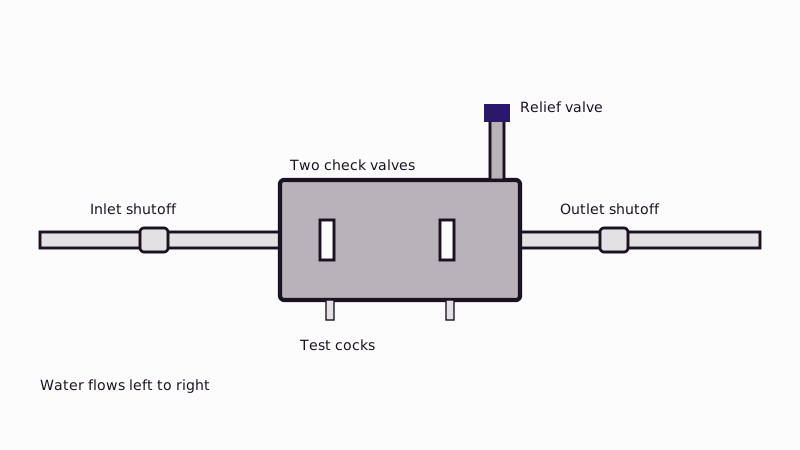
Nobody tests a backflow device by feel. A qualified tester hooks a calibrated gauge kit to small test ports on the assembly, closes valves in sequence, and reads pressures to confirm the check valves seal. A homeowner cannot reasonably do that from a hardware-store kit. What you can do is learn whether you own such a device and arrange the inspection. Permits for related plumbing work come after that, and the broader rulebook is gathered under permits, codes and gas plumbing.
What does a backflow assembly do, and do I have one?
The job of a backflow assembly is to keep dirty water from being drawn back into the street main during a pressure drop. Homes with sprinkler systems, fire lines, pools hooked to the supply, or commercial buildings commonly have one. A typical house with only hose bibs usually has simple vacuum breakers that are not tested individually.
Look along the sprinkler line near where it leaves the house: a bronze or brass body with two shutoff valves, usually just above ground and sometimes in a cage or green box, is the usual sight. Records or a tag should exist. If you are unsure, the water bill names your supplier, whose cross-connection staff can say what your property must have. On the Westside that supplier varies: Santa Monica runs its own water department, most Los Angeles neighborhoods get service from LADWP, and several cities have their own systems, so the bill is the quickest way to check.
How does a qualified tester check the assembly?
With the water shut, the tester screws a gauge set onto the small test ports and takes a sequence of pressure readings over every check valve and over the relief valve. A passing unit blocks reverse flow and vents as designed. A failing unit gets repaired or swapped and is then tested again.
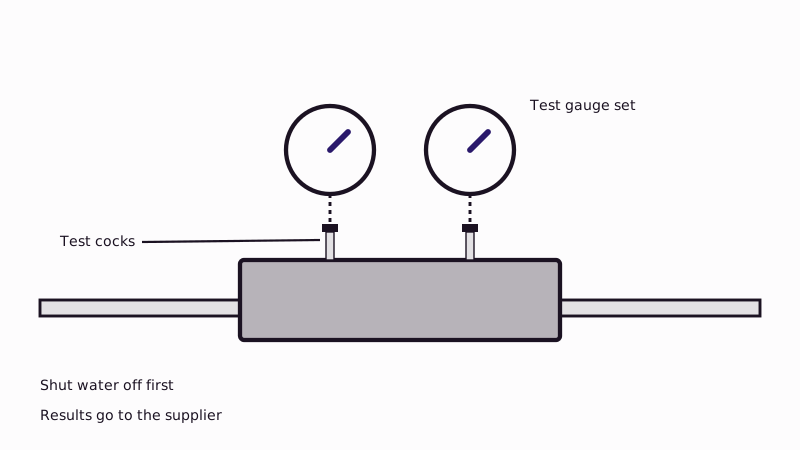
Specific readings depend on the assembly type, and the tester follows the manufacturer and state procedure. That is why paperwork matters: a result sheet should list the device make, serial number, location, the readings, any repairs, and the date, and it goes to the water supplier. The State Water Board's handbook says required field testing must be carried out by backflow assembly testers. Never accept a verbal "it's fine" in place of the report.
How often must it be tested?
Once a year at minimum, according to the state's Cross-Connection Control Policy Handbook from the Water Board, with more frequent checks possible if the water system or the county health department asks. The water supplier tracks the due date and sends notices, so watch your mail and check the account on your water bill.
The same handbook says that after a failed test, the water system should see that the assembly is repaired or replaced within 30 days of the failed test. Ignoring a notice can end in service shutoff, so treat the letter as time-sensitive. A new assembly, or one that has been moved, also needs a first test after installation. Money questions go to what backflow device testing costs; buildings with several assemblies belong with commercial backflow testing.
Who is allowed to test and repair it?
A tester must hold the qualification the state and the water supplier recognize, and many suppliers keep a list of approved testers. Fixing or replacing the assembly counts as plumbing work, and a contractor license is required when work and parts reach $1,000 or when the job needs a permit.
Ask the tester for a credential number and confirm the supplier accepts it, since a report from an unapproved tester may be rejected. On repair work a deposit may not exceed the smaller of 10 percent of the job or $1,000, so anyone wanting more in advance deserves suspicion. More on the whole sequence is on the backflow prevention and testing page.
Can I apply for the permit myself in Santa Monica?
Per the city's homeowner guide, the owner of the property, or a contractor holding the right state license, may take out the permit. Small jobs use a Single Trade Permit at the Building and Safety counter; the guide names water heater change-outs, sink replacements and re-piping. Bigger projects fall under a Combination Permit.
A few points from that guide, which is an older document, so confirm details with the city:
- Single Trade permits often do not require plans; larger jobs usually do.
- Contractors bring their state license, a city business license and proof of workers' compensation.
- An owner-builder signs a declaration form and shows identification.
- Inspection approval is needed before any work is covered up.
- The city charges a reduced fee for Single Trade permits to encourage inspections.
The Municipal Code, section 8.08.050, says nobody may alter or repair building service equipment without a permit from the building officer, with listed exceptions such as clearing stoppages or fixing leaks without replacing pipes, valves or fixtures. Water heater swaps are absent from that list, which is why the water heater permit question has a guide of its own.
What about permits in Venice, Brentwood or other Los Angeles neighborhoods?
Venice, Brentwood, Westwood and Pacific Palisades are neighborhoods of Los Angeles, so permits come from the city's own building department rather than Santa Monica's. Culver City, Beverly Hills, West Hollywood and Malibu each have their own permit counters or contract arrangements, and requirements differ.
Offices and online systems change, so the safest step is to ask the visiting plumber which office handles your address, or phone the relevant building division. Every neighborhood we cover appears on where we work, and inspection pricing has its own. The CSLB reminds consumers that a permit must be obtained before work and that local departments set their own rules.
How do I fill out a permit application correctly?
Describe the work in plain terms: location, what is being replaced or added, fixture counts, and who is doing it. Use the property owner's name and the exact address, give the contractor license number if one applies, and state the job value honestly. Counter staff will correct mistakes, and an honest scope avoids a failed inspection later.
Drawing plans is usually unnecessary for a like-for-like repair, but a sketch showing pipe routes and the position of the device helps. Where plans are required, the city guide suggests an experienced design professional. If a plumber is doing the job, the plumber typically files the application, and your role is to sign what is yours and keep the permit card where the inspector can find it. Sunset Coast Plumbing is the starting point when you would like a local plumber to explain which permit your job needs.
Common questions
Is a do-it-yourself backflow test allowed?
Not for compliance. Water systems accept results only from recognized testers, using a calibrated gauge, and the test results have to reach the supplier. You can inspect the device for leaks, keep it from freezing or being buried, and note its location. For the official test, book a tester and keep the report.
Does a hose bib vacuum breaker need testing?
Generally no. The small screw-on vacuum breaker for a garden spigot is a simple device and is not tested like a larger assembly. It can wear out, though, and should be replaced if it drips or fails to seal. Irrigation and fire-line assemblies are the ones that usually carry a yearly test requirement.
What follows a failed test?
A repair comes first where possible, otherwise the assembly is replaced, and then a fresh test happens. The state handbook tells water systems to see that a failed assembly is repaired or replaced within 30 days. Hang on to every report; the supplier may want both the failing and the passing one.
How do I get this priced?
Describe the device, where it sits and any notice you received through the quote page. The price comes back in writing before a local plumber starts. A notice with a deadline should be mentioned by date so scheduling can work around it.
Sources used
Page updated