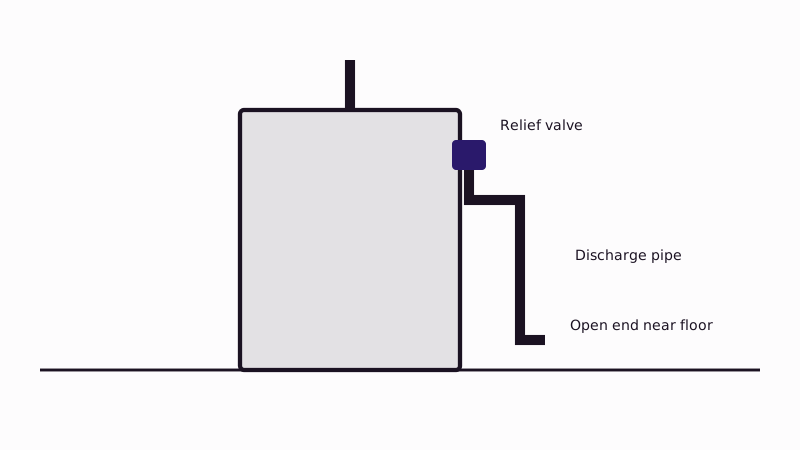
Water beading at the small lever fitted to the upper part of a tank is a message. Perhaps the valve itself is tired. Perhaps the tank is reaching temperatures or pressures it never should. Swapping the valve fixes only the first. Below you can separate the two, see what Fixr's national guide shows for the price, and learn why this part belongs to a trade professional. The wider picture lives under water heater repair.
What does a water heater relief valve do?
Its job is to let water out whenever heat or pressure in the tank rises beyond safe levels. Wikipedia's water heater article calls it a safety fitting, notes that a pipe carries the released water away from the living area, and cautions that a heater lacking its safety devices can explode.
So never plug, cap or crank down a dripping valve to quiet it. Silencing the valve removes the protection. A discharge pipe that has been shortened, clogged or narrowed does the same.
Beneath it waits a hot, pressurized vessel and, on a gas model, a burner that stops only if the thermostat and gas control work. The valve is the backup layer, and a backup that has been disabled is worse than none.
How do you know the valve needs replacing?
Signs include moisture at the valve or its drain pipe, a white or green crust around the outlet, a lever fused in place, or a valve that runs continuously. A valve that refuses to open when tested is as bad as one that leaks, though testing a hot tank is a task for a trade professional.
A drip does not always mean a bad valve. Three situations can cause one:
- A worn valve. The seat has scaled or hardened and seeps under ordinary conditions. A new valve cures it.
- High supply pressure. Heated water expands, and if incoming pressure is already high, the valve opens to relieve the excess.
- Trapped expansion. A check valve or regulator on the house line can trap the extra volume. An expansion tank gives the surplus somewhere to go.
A fresh valve that starts weeping within days usually points at the second or third cause. One fix is explained under expansion tank replacement, the other under pressure regulator adjustment.
Houses at the bottom of a long grade, as in parts of Brentwood and Pacific Palisades, can receive higher pressure. A gauge threaded onto a hose connection outside shows what arrives, and a trade professional can interpret the reading.
What does replacing one cost?
Fixr's national figures: $100 to $250 to replace the valve, $75 to $150 for a general valve repair, labor at $50 to $150 per hour, and $100 to $200 extra for urgent calls. These are guides only. Your own written estimate sets the price, and it should state whether a new discharge pipe is included.
The part is small. Most of the charge covers the visit, draining some water, fitting the new valve and testing for leaks. If the plumber finds an old tank with rusty fittings or a leak at the shell, talk turns to replacement. Across all heater repairs Fixr reports $150 up to $750, centered on $450; what a new heater costs shows the other side of that choice.
Before agreeing, ask: is the discharge pipe in the price, is the new valve rated for this tank, and what happens if the drip returns after the swap?
Is changing the valve a DIY task?
This is no DIY project. The tank is hot and pressurized, and it connects to gas or a heavy electrical circuit. In California the C-36 contractor classification is what covers water heaters and gas, and a poor joint or the wrong valve rating can fail at the worst moment.
What you can safely do: look at the valve and its drain pipe, check for puddles, note when it drips (only while heating, or all day) and photograph the tank label. Keep clear of the valve's outlet, because it can release scalding water.
Leave the gas side alone. A gas smell sends everyone out the door; the phone call to SoCalGas happens outdoors, at 1-800-427-2200. The plumber takes care of the rest. Water leaking from the tank shell, not the valve, means a replacement; the emergency page says what to turn off meanwhile.
What should you switch off until someone arrives?
Cut the heat first: set a gas model's control to off, or trip the breaker feeding an electric one. Then close the cold inlet above the tank, leave hot taps shut and keep kids and animals clear of the discharge pipe until the plumber has looked.
If water is pouring from the valve, leave the lever alone, since it can scald. Shutting off fuel and the cold inlet slows things down, and a bucket placed under the discharge pipe catches the flow. Then book a visit rather than waiting to see what happens.
Skip the tank's drain spigot unless a hose runs from it to a floor drain; the water inside is hot enough to burn.
Where should the discharge pipe end?
According to Wikipedia, most plumbing codes send the discharge pipe to a drain or out of the living space, and some allow it to finish in a garage. Rules differ by city, so a plumber confirms what the building office in Santa Monica, or your own city, expects at your address.
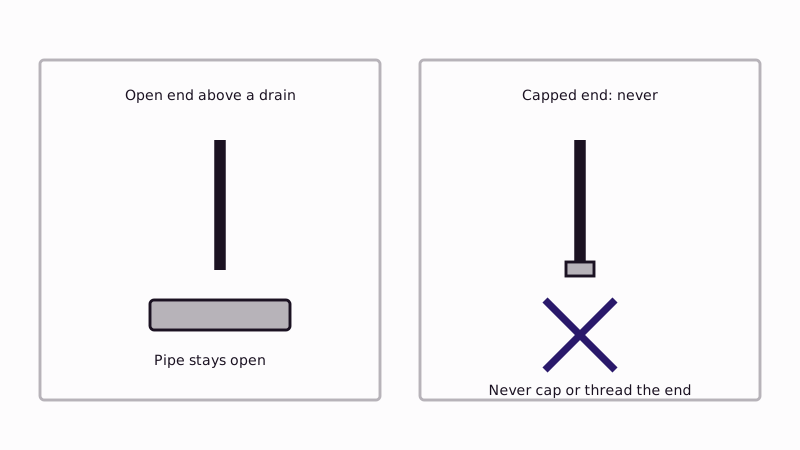
A pipe that stops an inch above the floor on a tiled laundry room can look fine and still be wrong. The plumber should confirm the length, the material, the slope and the termination point. Never thread the end or screw a cap onto it.
Wikipedia also says gas or propane heaters in a garage should usually sit raised off the floor, and that tank heaters may need strapping in earthquake country. Those are separate fixes from the valve, though a plumber on site can glance at them.
Common questions
What makes the valve on my heater drip?
Either the seat has worn, or the tank is reaching heat or pressure the valve was built to relieve. A new valve solves only the first case. If the drip comes back, have the supply pressure, the thermostat and the need for an expansion tank checked.
Should a weeping valve worry me?
It can be. Wikipedia warns that a heater without working safety devices can explode, and a dripping valve may be the only warning you get. Do not plug it. Shut off the heater and the cold inlet, then arrange a visit. Steam, a roaring noise or a gas smell means leave the house.
What should the part and the swap cost?
Fixr's national guide shows $100 to $250 for a replacement and $75 to $150 for a repair, plus labor of $50 to $150 hourly and an urgent surcharge of $100 to $200. Your house gets its number from the written quote.
How many years does the valve itself last?
No sourced lifespan turned up, so we give no number. Scale and age wear the seat, and a servicing visit is the natural time to look at it. If yours is old, crusty or has never been checked, ask for an inspection.
Does swapping the valve alone need a permit?
A city source confirming that was out of reach. Santa Monica does list hot water heater change-outs under its Single Trade Construction Permit. Raise it with the plumber and at the permit counter before work begins, and hold onto any paperwork that results.
Want the valve examined? A visit can be requested through the quote page, and the Sunset Coast Plumbing home page lists the other services.
Sources used
Page updated