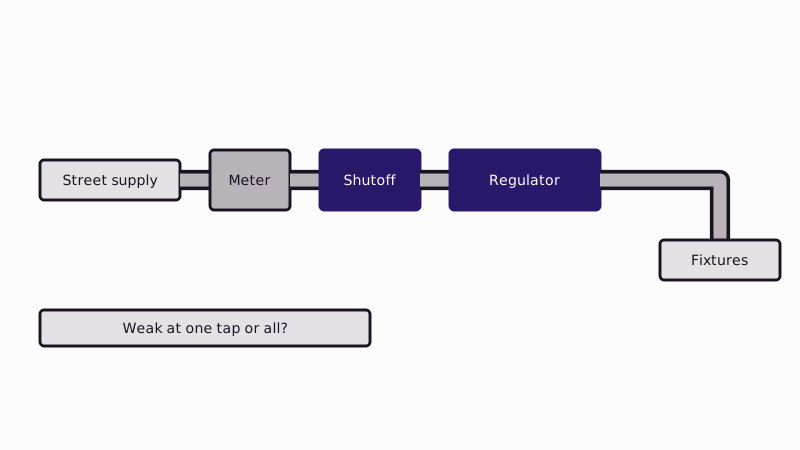
A single tap that dribbles probably has grit in its aerator or a shutoff open only partway. When the whole house is sluggish, start where water enters the house, with the main valve, then the regulator, rusted supply pipe, a leak out of sight, or weak pressure in the street. Only hot water weak? Think water heater. Match your symptom below. The wider subject of water pressure and valves explains what a visiting plumber takes on when a screwdriver is not enough.
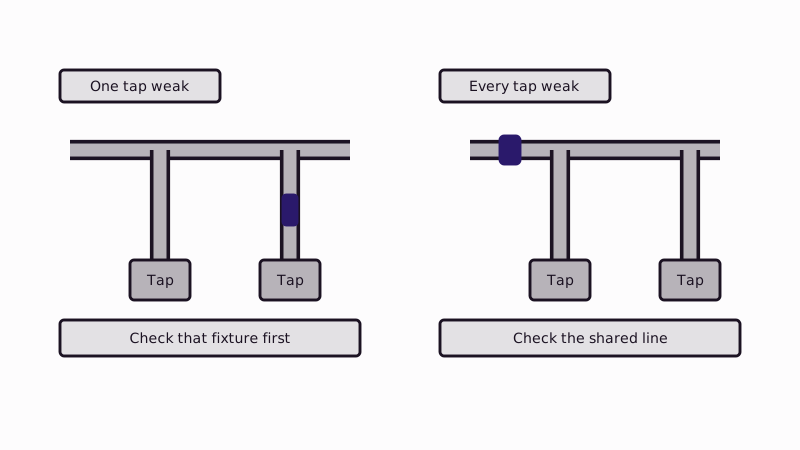
Does the weakness follow one tap or every tap?
Open each tap and shower in turn and compare them. If only one outlet disappoints, suspect something at that fixture: a gritty aerator or shower head, a pinched flex hose, a stop valve someone barely opened, or a tired cartridge. Weakness everywhere means the cause sits upstream, somewhere between the street and the first branch inside the walls.
Quick tests, in order:
- Spin off the aerator and run the tap bare. Strong flow without it means mineral grit was choking the screen.
- Look at the valve beneath the sink and open it fully.
- Test another tap in the same room for comparison.
- Set hot against cold. Weak hot alone implicates the water heater, its shutoff or the hot-side pipe, a case handled under low hot water pressure.
What starves an entire house of pressure?
Usual suspects: a meter or shutoff handle that was never swung fully open again, a failing regulator, galvanized supply pipe rusted narrow, a leak, or a fault on the utility's side. Overnight drops tend to be a valve or a break; a slow slide over months tends to be corrosion inside old pipe.
- Valve left partway: after plumbing work or a meter swap, a handle may not have gone back to wide open. Give it a full turn.
- Regulator failure: a tired pressure reducing valve can stick low or high; only a gauge reading shows which.
- Galvanized pipe: common in houses older than about 1960, where rust closes the bore a little each year. Details sit under galvanized pipe replacement.
- Hidden leak: water escapes before it reaches the fixtures. The EPA's two-hour meter check exposes it.
- Utility: a main break or scheduled work can sap a whole block. Ask a neighbor, then the provider.
What reading counts as low?
Thread a pressure gauge onto the spigot at the front or back of the house, confirm every indoor fixture and appliance is idle, then note the needle. Hardware stores stock them cheaply. Most households feel comfortable between 40 and 60 psi. Beyond 80 you have the reverse problem, because the plumbing code requires a pressure reducing valve once the supply passes that figure.
Read it at breakfast and again at dinner, because street pressure moves with neighborhood demand. Figures under roughly 30 psi explain feeble showers. A figure far above 80 means the regulator needs attention, and a walkthrough on regulator adjustment pictures the valve and explains why turning its screw is not always the answer.
Why do some Westside homes have lower pressure than others?
Mostly elevation and distance. Houses high in Brentwood, Pacific Palisades or the Malibu canyons sit above their water mains and may depend on booster pumps or storage tanks, so pressure follows system design. Santa Monica, the LADWP neighborhoods, Beverly Hills and Culver City run separate systems, so your own provider is the one to ask about typical pressure on your street.
Flatter ground in Santa Monica and Venice tends toward steadier pressure, though older houses there can still lose flow to galvanized pipe. A tankless heater on a long run may feel weaker at the farthest bathroom, which is a sizing issue rather than a pressure fault.
Does low pressure put anyone at risk?
Mostly it irritates rather than endangers. It can, though, be the first hint of a leak or main break, and a sudden drop paired with a high bill deserves a look. Competing irrigation can also steal flow. In rare cases a supply pressure drop lets water flow backward, which is the reason backflow devices exist.
If pressure falls sharply and the meter dial spins with every fixture shut, a leak is the likely reason, so close the main. Cloudy or discolored water arriving with the pressure loss is a reason to stop drinking from the tap and contact the water provider.
Which fixes belong to a plumber?
Flow still poor with the main wide open? Or a dead regulator suspected, rusted pipe or a leak? Then it is plumber territory. Regulator swaps and pipe work are plumbing jobs, and many cities require a permit, so ask the building office for your address.
Bigger jobs also trigger state rules: California draws a line at $1,000 for labor plus parts: above it the contractor needs a state license, and deposits face a cap. List your findings on the quote page, gauge reading included, and a visit gets arranged. Further steps are on the page about fixing low pressure at home.
Common questions
How quickly can the cause be pinned down?
Grit in an aerator or a half-shut valve reveals itself within minutes. For a house-wide fault, expect a plumber to spend an hour or two on a gauge reading, a meter test and an inspection of the regulator. Hidden leaks and corroded pipe stretch that out considerably.
What explains pressure that vanished overnight?
Think about what changed: a valve someone moved, a regulator that died, a pipe that split, or utility crews working on your street. Check the main valve, then ask neighbors whether they notice it too. A meter dial that creeps along with all fixtures closed means water is escaping. The guide to sudden low pressure lists more causes.
May I turn up the regulator on my own?
On many models, yes, but only once a gauge shows the pressure sits below target. The plumbing code tops out at 80 psi, and cranking the screw without a reading can harm appliances, the water heater and supply hoses. When a regulator is old, replacing it usually beats adjusting it.
Would a booster pump fix it?
Sometimes, for a home perched high on a hillside or the last one on a long supply line. It cannot cure corroded pipe or a leak, though, and it adds one more part that can fail. Have a plumber check the supply side first, and measure before spending on any equipment.
The rest of our guides start from Sunset Coast Plumbing.
Sources used
Page updated