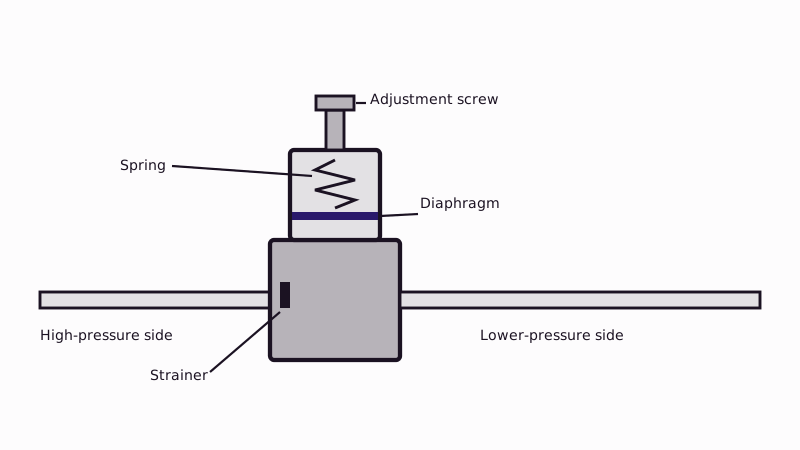
The utility sets street pressure to suit its own system, not your faucets. Between the main and your pipes sits a bell-shaped brass fitting, the pressure reducing valve (PRV), whose job is to bring that pressure down. Working, it goes unnoticed. Failing, it lets pipes knock, makes a heater's relief valve drip, and eventually leaves a joint to give way. Wider pressure troubles are covered under low water pressure; here the focus is the valve.
What is the regulator doing for my house?
It trims incoming pressure to a steady, tolerable level for the entire house. A spring and diaphragm inside open and close as conditions change, holding downstream pressure in a set band even when the street side swings, and shielding fixtures from every surge.
Skip it and every fixture, hose, supply line and appliance valve takes the main's full force, which punishes washing machine hoses, ice maker lines, toilet fill valves, cartridges and the water heater. Bob Vila notes that city pressure often exceeds what household plumbing can handle, hence the PRV. Treat it as a shock absorber for the whole system. Most sit on the incoming line shortly past the shutoff, and finding yours is the subject of locating a pressure regulator.
What pressure is normal, and when does the code require a regulator?
Bob Vila gives 40 to 80 psi as the normal home range. Under section 608.2 of California's plumbing code, expect an approved regulator and strainer whenever static pressure in the supply lines goes beyond 80 psi, and the result must be 80 or lower.
Static pressure means the reading with nothing running. Thread a cheap gauge onto an outdoor spigot, open the spigot fully while nothing else draws water, and read the dial; Bob Vila describes the same method. A number well above 80 says a regulator is missing or has quit. Pressure can run higher at the bottom of a slope than near the top, so houses on Brentwood, Pacific Palisades or Malibu hillsides are worth testing, though the gauge has the last word.
How does a tired regulator show itself?
Bob Vila lists pressure that swings, starts strong then fades, or stays low throughout. On the high side, expect banging pipes, a relief valve at the heater that dribbles, spitting fixtures and toilets that refill by themselves. Confirm any suspicion with the gauge.
Springs weaken, debris clogs the strainer or seat, and diaphragms tear, so a worn regulator can fail in either direction, too low or too high. Weak hot water alone points at the heater instead. Other explanations are collected in why water pressure drops. Test at the spigot with everything else off, since aerators and fixture filters can mask the picture.
Can I turn the adjustment screw myself?
A lot of regulators carry an adjustment bolt with a lock nut, so a small change is possible with a gauge attached. Bob Vila warns that bad adjustments can damage plumbing and calls it a job for a plumber. Anyone who tries should make small turns, rereading the gauge each time.
Steps and cautions appear in adjusting a regulator valve. Know where adjustment ends: a valve that cannot keep its setting, creeps up overnight or weeps at the bell is finished and needs replacing. Remember too that 80 psi is a ceiling, and where you land beneath it is a balance of comfort and protection that a plumber can help strike.
What will a new regulator set me back?
Per HomeGuide, most replacements land at $300 to $650 with labor and materials, averaging $475 nationally. Angi lists an average of $400 and a usual spread of $200 to $700. These are national guides; your number comes with the written quote.
More from those guides: HomeGuide puts labor at $225 to $450, mostly three hours or less. Angi shows $200 to $400 for a three-quarter-inch residential valve, $300 to $600 for one inch, and $150 to $300 more for permit and inspection fees. After-hours visits cost more. Line items are broken out in pressure regulator installation pricing. Have the quote name the valve size, brand, strainer and expansion tank plan.
Why does a regulator often come with an expansion tank?
Once a regulator is in, the plumbing becomes a closed loop. Warmed water swells, finds no outlet, and pressure jumps. An expansion tank on the cold side is often needed to take up the swelling, so ask your plumber whether your system calls for one.
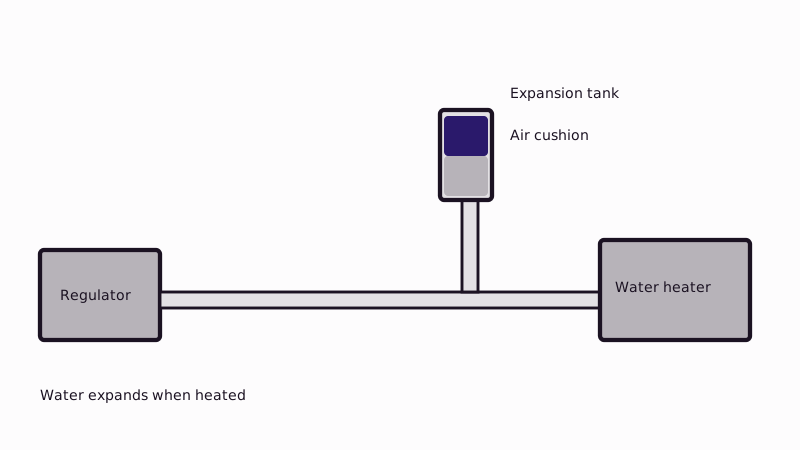
So a plumber fitting a regulator usually checks or adds a tank near the water heater. Without one the relief valve may weep and fixtures take abuse, and thermal expansion can make a good regulator look faulty. Ask whether you have a tank, whether it is charged and whether it is sized right. A tank with a failed bladder is a classic reason a new regulator seems to change nothing.
Does replacing one need a permit?
License rules and permit rules are separate. California's contractor license rule applies at $1,000 or more, or for any job needing a permit, and permits are not price-based. Santa Monica's code requires one for altering building service equipment, and the exceptions it lists do not include replacing valves. Ask the plumber who files it.
Section 8.08.050, from an excerpt of the Santa Monica code, exempts clearing stoppages and repairing leaks that do not replace pipes, valves or fixtures. A regulator swap replaces a valve, so a permit may apply; the city or the plumber can confirm. Los Angeles neighborhoods answer to that city's building department. Contract deposits are limited by law; ask the CSLB or the plumber what the cap is on your job. A local plumber can be lined up through Sunset Coast Plumbing or the quote page, where you can note the symptoms and your gauge reading.
Common questions
How long before a regulator needs replacing?
None of the guides reviewed here states one lifespan, since water quality, pressure and model all matter. They do wear out, so a gauge check every year or two is cheap insurance. Creeping pressure or a leaking valve means replace it before it fails outright.
What setting should the regulator be on?
Code tops out at 80 psi, and Bob Vila's normal band runs 40 to 80. Inside it, the right setting trades shower strength against fixture protection. A plumber dials it in with a gauge on the line and rechecks after the system refills. Chasing a bigger number just for stronger flow is not worth the wear.
Is low pressure also a regulator problem?
Sometimes. Bob Vila counts steady low pressure, swings, and a strong start that fades among signs of a failing regulator, though a clogged strainer or a main valve left partly shut can cause the same. Test at the spigot first, then have a plumber inspect the valve and strainer.
Do I need one if my pressure is under 80 psi?
Not by that code section, which applies above 80 psi static. Some homes are fine without one. But pressure can change when the utility adjusts its system, so an annual gauge check on a hose bib is the way to know. The first reading above 80 turns a regulator into a requirement.
Sources used
- California Plumbing Code 608.2, excessive water pressure (2025 edition, via GoCodeBook)
- Bob Vila, low water pressure
- HomeGuide, cost to replace a water pressure regulator
- Angi, water pressure regulator replacement cost
- Santa Monica Municipal Code 8.08.050, permits required
- California Contractors State License Board, hire a contractor
Page updated