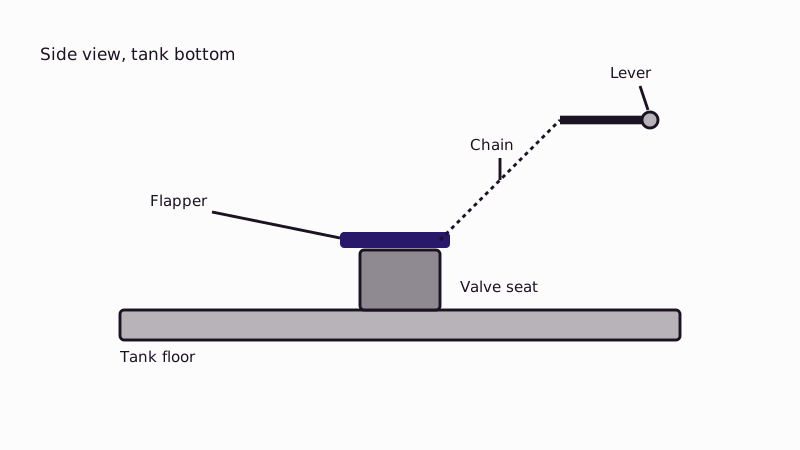
Take off the tank lid. Down at the tank's floor, a rubber disc sits over a drain hole. People call it the flapper. Flushing raises it, and gravity lowers it again to seal the tank. Once the rubber warps or goes slimy, tank water slips into the bowl a little at a time, and the fill valve restarts to compensate. Replacement parts are cheap. Wider toilet trouble lives on the toilet repair page.
Which clues point at the flapper and not the fill valve?
Listen and watch. A toilet that sighs or refills every few minutes with nobody near it is classic flapper behavior. So is a tank that never fully stops hissing. A misbehaving fill valve behaves differently, with water spilling into the standpipe in the middle, or the tank rising beyond its line. Verify with dye, because guessing means buying the wrong part.
Tint the tank with some food coloring, then do not flush for ten minutes. Dye that reaches the bowl shows the seal is failing at the flapper or its seat. WaterSense, the EPA's program, recommends this exact test and suggests swapping flappers about every five years or sooner. Flush afterward to keep the tank clean. Check the chain as well: if it is pulled tight the flapper hangs slightly open and imitates the leak.
How much water vanishes through a quiet leak?
More than most people guess. For context, The EPA's WaterSense pages list 9,300-plus gallons lost per year in an average home, with roughly one home in eleven losing 50 gallons or more a day. Toilets are among the usual sources, because the loss makes no noise to speak of and never shows as a puddle.
Try an overnight version. At bedtime shut the valve behind the toilet, mark the tank's waterline with a pencil, and compare in the morning. If the level dropped, the flapper let it go. That single check, backed by a glance at your recent bills, tells you whether the repair is urgent or can wait for the weekend.
How is a flapper actually replaced?
Start by closing the supply valve and flushing the tank dry. Then take the chain off the lever. The old flapper pops free from two small posts on the overflow tube, or from a ring around it. Seat the replacement on the pegs and loop the chain on with a little give, roughly the width of a thumb. Open the valve again, then flush repeatedly and look for any trickle past the seal.
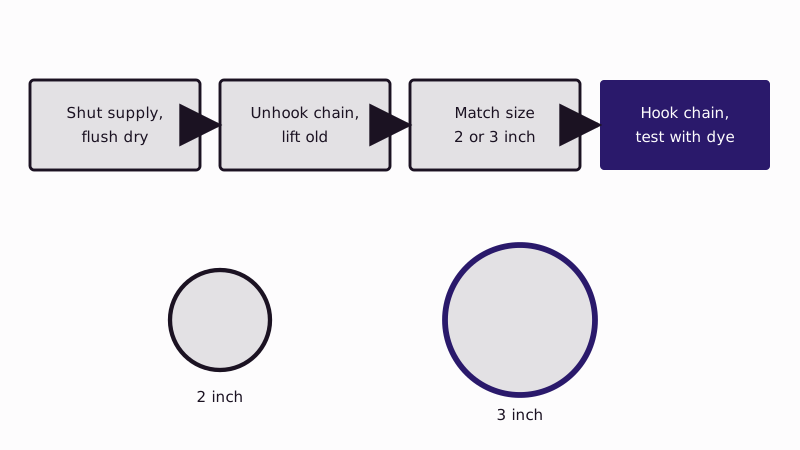
Size is where people go wrong. Most older tanks take a 2 inch flapper, and many newer or low-flow designs take 3 inches; the wrong diameter either leaks or flushes weakly. Carry the old flapper into the store with you, or photograph the tank interior and its maker's label. Universal adjustable flappers exist, but a model-matched part generally seals better.
What makes flappers wear out so quickly?
Blue chlorine tablets in the tank rank high, since concentrated chemical eats rubber. Mineral crust on the seat stops a clean seal, and ordinary age stiffens the material until it cannot conform. A chain with too much slack can wedge under the flapper. A gentle wipe of the seat with a soft pad can revive a seal that merely looks dirty.
Hardness differs by water supplier, so crusting can vary between a Santa Monica kitchen and a Westwood bathroom. Steer clear of steel wool or hard scouring pads on the seat. A pitted or cracked plastic seat will defeat any flapper, in which case the seat needs a repair kit or the whole flush valve needs replacement.
The new flapper still leaks. What next?
Retest with dye. If color still creeps into the bowl, suspect a damaged valve seat, a wrong-size part or a chain pulling the flapper up. If the water instead flows over the overflow tube, the fill valve is overshooting and needs adjusting or replacing; replacing a fill valve explains that job.
After two flappers with no change, stop buying parts and consider that the seat is the culprit. A longer walkthrough, stopping a toilet that keeps running, takes you through every cause in order. Water puddling around the base is a separate case, typically the wax ring.
At what stage do you hire help?
Pass the job on when the wall valve is stuck or weeping, the flush valve has corroded, parts for an elderly toilet cannot be found, or two tries have not worked. A plumber can rebuild the flush valve or swap the toilet. Ask your water supplier about toilet rebates if replacing is on the table.
Tell us the toilet's age and symptoms through the quote page; a written price comes back before anyone visits. For a cable-clearing problem instead, see the clogged toilet page.
Common questions
What is the time commitment?
About ten minutes for the swap itself, with a few more to test several flushes. The first try may run longer while you hunt for the right size. During a plumber visit it adds little time, though a minimum trip charge can apply. A stuck wall valve is the main thing that stretches the job.
What does a flapper cost?
Hardware stores sell them cheaply, including adjustable and model-specific types; prices differ by brand and shop. A plumber adds labor and a trip charge. Done yourself, this is one of the lowest-cost repairs in the house, and reduced water waste can recoup the price fast.
Can I do this without calling anyone?
For the flapper, chain and fill valve, yes: they are hand-tool jobs. Call someone for a cracked tank, a corroded shutoff or a damaged seat. A flapper job sits far below California's $1,000 contractor license threshold, though a larger quote should show a license number you can check with the state.
What goes into a plumber's quote for this?
A trustworthy estimate separates parts from labor, names the flapper or valve size, ends with a test flush, and discloses any trip charge. Have it written down, and keep the failed part if you are curious about why it gave out, since the wear pattern often explains the cause.
Should someone be at home?
An adult should unlock the door, point to the toilet and approve anything extra a flapper job turns up, since worn fill valves and shutoffs often show up at the same time. Clear the bathroom floor beforehand and keep pets away from open tank water.
For the wider picture, start with plumber santa monica.
Sources used
Page updated