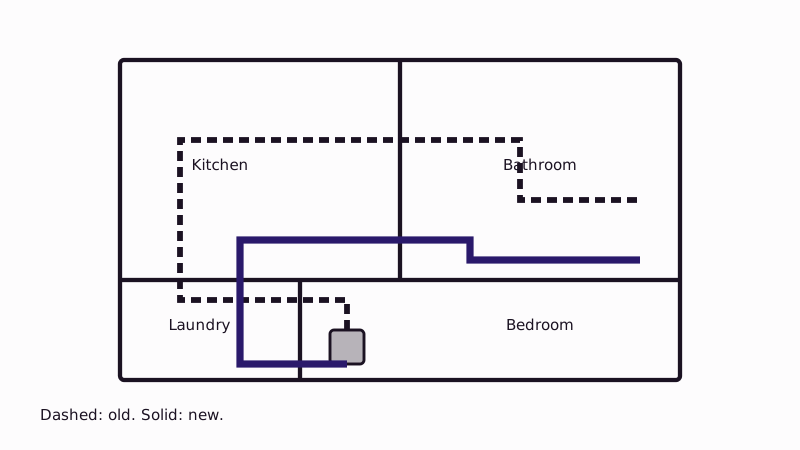
Bob Vila's national guide puts a whole-house repipe at $1,500 to $15,000, averaging $7,500. It gives no California or Los Angeles figure, so a Santa Monica house may land outside that range, and only a written quote settles it. Below is what hides inside those totals. For other services, see the home page.
Treat these as ballpark. A Santa Monica house only gets a true price after someone inspects the pipes and writes it down.
What is a full repipe going to cost me?
Bob Vila's guide shows $2,280 to $5,120 for the pipe work in a compact three-bedroom of 1,500 square feet, with PEX at $0.40 to $2 a foot and copper at $2 to $8 a foot. Wall patching and paint are billed apart, with drywall repair listed at $50 to $75 a square foot, and a larger house will cost more than the compact one.
What changes the number:
- Pipe material. PEX is cheaper per foot than copper in the guide above, often by a wide margin. The PEX versus copper comparison explains the trade-offs.
- Size and layout. More bathrooms, a second floor, and long runs add pipe, fittings and hours.
- Access. A raised-floor house with a crawl space is easier than a slab house, where lines run through walls and ceilings.
- Wall repair. Cutting access holes is part of the job; patching and painting them may be a separate line or a separate trade.
- Permit. Bob Vila lists permits at $50 to $500 nationally; check that your quote carries a permit line.
For a deeper breakdown, see the repipe cost guide.
Which old pipes drive the cost up?
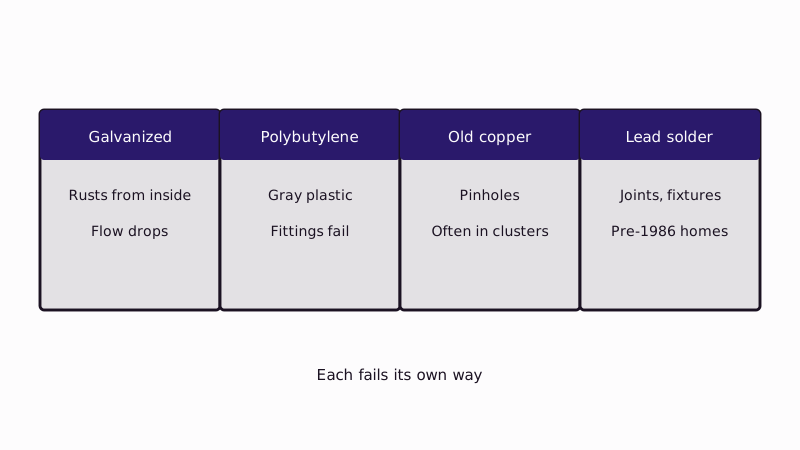
Galvanized steel, polybutylene, old copper with pinhole leaks and lead-soldered joints are the pipes that make people replace plumbing. Each has a different failure and a different bill. Replacing galvanized pipe is quoted by material and footage, and the same written quote should say what is being swapped.
How the old materials differ:
- Galvanized steel, typical of houses built before the 1960s, rusts from within and slowly closes the bore until flow falls. See galvanized pipe replacement.
- Polybutylene was a gray plastic installed in many homes from about the late 1970s through the 1990s. Its fittings have a failure record, so owners often replace it before it leaks. It has its own page: polybutylene pipe replacement.
- Copper with pinholes. Pinhole leaks in older copper can show up in clusters in the same house; patching each one may cost more over time than a repipe.
- Lead solder and fixtures. EPA notes that lead turns up more often in homes built before 1986, coming from service lines, brass fixtures and solder. A water test is cheap and shows where you stand.
Cast iron and clay drains are a separate topic from supply pipes and are priced on their own, usually after a camera inspection.
Should you replace everything or only part of it?
A partial repipe is sensible when one section is failing and the rest tests sound. Replace it all when the material itself is spent, since opening walls twice costs more than opening them once. A plumber can price both so you can compare.
Limited work (one bathroom, or just the kitchen supply) is priced by scope, so ask for a written figure. It can also leave a mixed system where old galvanized meets new PEX or copper, and that needs the right transition fittings.
Leaks in only one spot call for a leak detection visit to see if the remainder is healthy. Houses with pipes under concrete face the same choice; read slab leak repair or repipe.
Which extras surprise people on the final bill?
Four items regularly get missed: permits and inspection, drywall and paint, new shutoff valves plus a regulator, and the hookups at the water heater. Some quotes fold them in, many leave them out, so ask for every line itemized and nothing stays hidden from you.
- Permits: the City of Santa Monica's building permit office handles plumbing permits in town, and its homeowner guide lists re-piping among work handled by a single-trade permit. Brentwood, Westwood, Venice and other Los Angeles neighborhoods use LADBS.
- Water heater tie-in and earthquake strapping, if the heater is moved.
- A pressure regulator, which the California Plumbing Code makes mandatory above 80 psi of static pressure.
- Asbestos or lead in an old house, which can add testing and special handling.
- Living arrangements: the water is off for stretches over a few days, and some households decamp.
What lowers the total without cutting corners?
Line up two estimates written to the same scope, pick PEX or copper depending on your time horizon in the house, and pair the work with other open-wall projects such as a bathroom remodel. A deposit on home improvement work cannot exceed the lesser of a tenth of the contract or $1,000 in California.
Check each estimate against one list: material, fixture count, wall repair, permit, cleanup and follow-up support. A rock-bottom bid with no patching can turn expensive later. Work above $1,000 needs a state contractor license, and the board's online search shows status and complaints. The quote page is where estimates get started.
Common questions
Is it cheaper to repair old pipes than to replace them?
For a single failure, yes: one leak repair is a few hundred dollars. With galvanized or polybutylene pipe, or several leaks in a year, the repairs pile up and may pass the price of a repipe. A plumber can tell which case you are in after looking at the pipe and testing it.
Will my policy pay for new pipes?
Usually no. Policies tend to cover sudden, accidental water damage, for instance after a burst, yet not wear-and-tear replacement of aging pipe. Your own policy and insurer have the last word on that, and the guide to burst pipe insurance explains the typical limits.
How long does replacing old plumbing take?
Ordinary houses take several working days, bigger or multi-story ones longer, with the taps dry through the workday. Patching and paint come afterward. Request a schedule with the estimate, including the hour the water returns each evening, so you can plan meals and showers.
Do I need to move out during a repipe?
Many owners stay put, since service resumes each evening. Expect dust, noise and holes in walls. Families with infants, or anyone who needs water all day, sometimes rent elsewhere for a few nights. Get the daily routine explained before the first pipe is cut.
Sources used
Page updated